
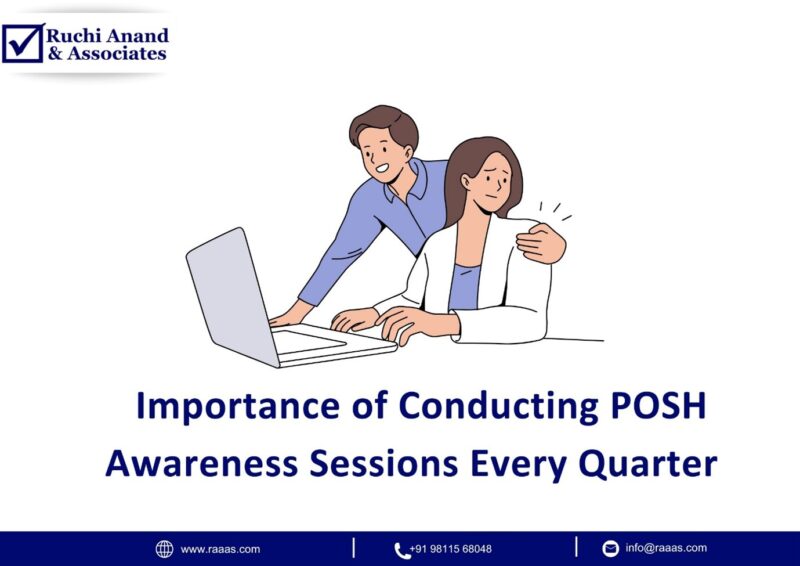
Importance of Conducting POSH Awareness Sessions Every Quarter
In today’s progressive work culture, the safety and dignity of employees, especially women, are non-negotiable. While having an anti-sexual harassment policy is mandatory under Indian law, mere compliance on paper does not guarantee a safe work environment. The real game-changer lies in cultivating awareness and sensitivity. One of the most effective ways to do this is by conducting quarterly POSH (Prevention of Sexual Harassment) awareness sessions. These sessions don’t just ensure legal compliance but actively contribute to building a respectful, inclusive, and productive workplace culture.
In this blog, we’ll explore in depth the legal requirements, benefits, challenges, and best practices for quarterly POSH training—and how expert firms Ruchi Anand and Associates help organizations turn compliance into a culture of care.
Understanding the POSH Act: A Brief Overview
The Sexual Harassment of Women at Workplace (Prevention, Prohibition and Redressal) Act, 2013, or POSH Act, is aimed at protecting women from sexual harassment at the workplace. Key requirements include:
- Formation of an Internal Complaints Committee (ICC)
- Display of POSH-related posters and information
- Regular training and awareness for employees
- Annual filing of POSH compliance reports
Failure to comply with the Act can lead to penalties, including cancellation of business licenses. However, compliance should not be reactive—it should be proactive and preventive.
Understanding POSH: Legal Framework & Key Provisions
The Sexual Harassment of Women at Workplace (Prevention, Prohibition and Redressal) Act, 2013—commonly referred to as the POSH Act—was enacted to protect women against sexual harassment in the workplace. It applies to all organizations, whether in the public or private sector, with 10 or more employees.
Key Requirements Under the POSH Act:
- Formation of Internal Complaints Committee (ICC) in every office with 10 or more employees.
- Display of POSH policy and committee details in a visible area in the office.
- Mandatory POSH Awareness Training for employees and ICC members.
- Annual filing of reports on POSH complaints and redressal mechanisms.
- ICC Members must be trained and equipped to handle complaints with sensitivity and confidentiality.
While many organizations form ICCs and have a policy in place, awareness among employees remains low, resulting in underreporting and mishandling of complaints. This is where regular awareness sessions—preferably quarterly—can bridge the gap.
Why Conduct POSH Awareness Sessions Every Quarter?
1. Sustained Awareness and Reinforcement
One-time training sessions are easily forgotten. By conducting awareness sessions quarterly, organizations ensure that the concepts of workplace dignity, boundaries, and redressal mechanisms are continuously reinforced. Employees stay informed and vigilant, reducing the likelihood of misconduct.
2. Changing Workforce Dynamics
Modern workplaces are dynamic—with regular onboarding of new employees, contractual staff, interns, and gig workers. Quarterly sessions ensure that every new entrant is educated on POSH policies and reporting protocols without waiting for the next annual cycle.
3. Creating a Safe Reporting Culture
Quarterly sessions offer a platform to reassure employees about confidentiality and protection against retaliation. Repeated engagement helps break the stigma and fear around reporting harassment and builds trust in the ICC’s procedures.
4. Legal Compliance & Risk Mitigation
Failure to conduct awareness training can result in:
- Heavy penalties, including cancellation of licenses.
- Damage to brand reputation in case of legal proceedings.
- Reduced employee morale and high attrition.
Quarterly sessions demonstrate due diligence and proactive compliance, thus mitigating legal and reputational risks.
5. Empowering Bystanders and Managers
Most incidents are witnessed by others but go unreported due to fear or ignorance. Quarterly training empowers employees to:
- Recognize inappropriate behavior.
- Intervene when necessary.
- Support survivors and uphold a culture of respect.
Best Practices for Conducting Quarterly POSH Sessions
To ensure effectiveness, your POSH sessions should be:
- Interactive: Use role-plays, real-life scenarios, and Q&A rounds
- Inclusive: Involve male, female, and LGBTQIA+ employees
- Customised: Tailor sessions to specific departments or roles
- Expert-led: Bring in certified external trainers or legal experts
- Documented: Maintain records of attendance, materials, and feedback
At Ruchi Anand and Associates, we help organizations conduct customized POSH training workshops, aligned with their size, structure, and industry.
Best Practices for Implementing Quarterly POSH Sessions
If you’re considering initiating quarterly awareness programs, here are some best practices:
- Get Senior Management Buy-In
A top-down approach ensures that POSH is taken seriously across all levels and departments. - Integrate POSH with Onboarding
Every new joiner should attend a POSH session within 30 days of joining. - Use Multiple Channels
Leverage videos, quizzes, newsletters, e-learning modules, and posters alongside live sessions to reinforce awareness. - Involve Men and Other Genders
POSH is not just a “women’s issue.” Awareness must include everyone—as allies, bystanders, or potential complainants/respondents. - Review and Update Policies Annually
As legal interpretations evolve, so should your internal POSH policy and training content.
Measuring the Success of POSH Awareness Sessions
Success isn’t just about attendance. Key performance indicators (KPIs) for POSH awareness should include:
- Feedback scores and post-session assessments
- Increased comfort in raising workplace issues
- Timely redressal of complaints
- Year-on-year reduction in incidents
Our firm provides detailed impact reports after each quarterly training to help organizations quantify effectiveness.
How Ruchi Anand & Associates Can Help
With over 20 years of experience in compliance consulting, audits, and HR legal advisory, we offer:
- Quarterly POSH Awareness Programs
- ICC Member Training & Certification
- Policy Drafting & Review
- Annual Compliance Support and Reporting
- Customized Webinars and On-site Training
We understand that POSH compliance is not a formality—it’s a responsibility.
Benefits of Partnering with a Professional Firm
- Expertise in Law and HR Practices
Our trainers include legal professionals, psychologists, and HR specialists with deep knowledge of POSH, labor law, and workplace behavior. - Customized Content
Training is customized to suit your organization’s size, structure, language preference, and employee hierarchy. - Data-Driven Approach
We offer pre- and post-training assessments, feedback reports, and policy gap analysis to ensure measurable impact. - Credibility in Case of Legal Scrutiny
Having a reputed external firm conduct your sessions adds credibility and transparency, especially in case of internal investigations or external audits.
Conclusion: Awareness Is the First Step toward Prevention
POSH awareness is not just about ticking a compliance box—it’s about creating a safe, inclusive, and productive environment where every employee feels respected and protected. Conducting awareness sessions every quarter makes employees more informed, workplaces more ethical, and organizations more legally secure.
With expert partners like Ruchi Anand and Associates, companies can transform POSH from a compliance requirement to a core cultural value. Through structured sessions, customized training, and robust advisory support, we help you lead the way in workplace dignity and employee well-being.