
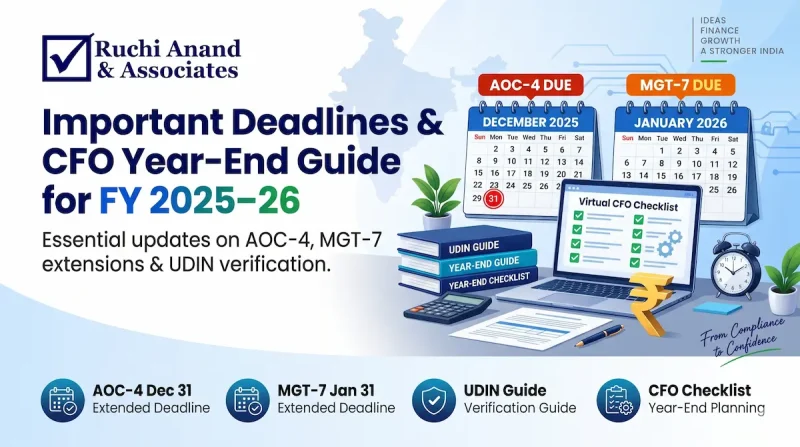
Extended MCA AOC-4 (Dec 31) & MGT-7 (Jan 31) Deadlines, UDIN Verification Guide & Year-End Virtual CFO Checklist for FY 2025–26
Quick answer: MCA General Circular No. 05/2026, dated October 24, 2026, lets companies file FY 2025–26 Form AOC-4 (including its CFS, XBRL and NBFC Ind AS variants) until December 31, 2026, and Form MGT-7 or MGT-7A until January 31, 2027, without the usual additional fee. It does not extend the AGM deadline of September 30, 2026. And every audit report or certificate signed by a practising Chartered Accountant needs an 18-character UDIN, which anyone can check on udin.icai.org.
Every year between late October and January, the same thing plays out in founder WhatsApp groups and finance teams across Delhi NCR, Mumbai and Bengaluru. The MCA announces a relaxation, and half the market behaves as if the Companies Act, 2013 has been put on pause. The other half leaves it to the last afternoon, then watches the filing bounce because a UDIN date doesn’t match, a director’s DSC is stuck, or nobody filed Form ADT-1.
We are Ruchi Anand & Associates (RAAAS), chartered accountants in New Delhi. Our statutory audit and Virtual CFO teams have spent more than two decades helping private limited companies, startups and foreign subsidiaries close their year. When Circular 05/2026 came out on October 24, the same three questions reached us within a day:
- “Does the extension protect us if our AGM was late, or if we haven’t filed Form ADT-1?”
- “Our auditor signed in September and we’re only now attaching the report. How does ICAI’s 60-day UDIN window affect us?”
- “Why does year-end always turn into a fire drill, and what does a Virtual CFO routine actually look like?”
This post answers all three. We go through what the circular does and doesn’t change, how UDIN verification works (no login needed), and the twelve-point checklist we run before a director signs and files.
What Circular 05/2026 Actually Extends, and Three Traps That Still Cost Money
Read the circular itself, not the WhatsApp summaries. After representations from industry bodies and professionals about audit-transition delays and MCA V3 validation problems, the Ministry waived the additional fee for two families of forms. That is the ₹100-per-day fee under Section 403 of the Companies Act, 2013. The normal filing fee and the statutory filing periods stay exactly as they were.
- Until December 31, 2026: Form AOC-4, AOC-4 (CFS), AOC-4 (XBRL), AOC-4 NBFC (Ind AS) and AOC-4 CFS NBFC (Ind AS). A companion circular gives the cost audit report, Form CRA-4, the same window.
- Until January 31, 2027: Form MGT-7, and Form MGT-7A, the abridged annual return for One Person Companies and Small Companies.
Due dates at a glance
| Item | Who it applies to | Original due date (AGM held Sept 30, 2026) | Under the circular | Additional fee |
| Holding the AGM | All companies except OPCs | September 30, 2026 (six months from year end) | Not extended | Section 96 default, with penalties under Section 99. |
| Form ADT-1 (auditor appointment or reappointment) | Companies appointing or ratifying an auditor | October 15, 2026 (15 days after the AGM) | Not extended | Normal slab-based additional fees, up to 12 times the normal fee. |
| Form AOC-4 and its CFS, XBRL and NBFC variants | All companies (OPCs: 180 days from year end, which is September 27, 2026) | October 30, 2026 (30 days after the AGM) | December 31, 2026 | ₹0 if filed on or before December 31, 2026. |
| Form MGT-7 / MGT-7A | All companies (MGT-7A for Small Companies and OPCs) | November 29, 2026 (60 days after the AGM) | January 31, 2027 | ₹0 if filed on or before January 31, 2027. |
| Form DIR-12 and other event-based filings | Companies with director changes | 30 days from the event | Not extended | Normal fee plus additional fee, counted from the original due date. |
Three traps that still trigger penalties
In our practice, the companies that get an adjudication notice after an extension are rarely the ones ignoring compliance. They are the ones who misread what the circular covers.
It is not an AGM extension
The circular says in so many words that it shall not be construed as extending the statutory time for holding AGMs. If you didn’t hold your AGM by September 30, 2026, and didn’t get an extension from the Registrar of Companies through Form GNL-1, filing AOC-4 in December does not cure that default. And please never backdate AGM minutes to fit a filing window. That can expose directors to prosecution under Sections 99 and 448.
The window is not a new due date
The circular pauses the ₹100-a-day fee. It does not reset the original due date. Say your AGM was on September 30, so AOC-4 was originally due on October 30. If you file on January 2, 2027, just two days after the window closes, the fee is counted from October 31, 2026. That is 64 days, roughly ₹6,400 on top of the normal fee, and the Section 137(3) penalties are still in play.
ADT-1 and director KYC are still live
Form ADT-1, the intimation of a statutory auditor’s appointment, is not covered. More important, check the DIN status of every signatory director before you upload AOC-4 or MGT-7. If even one director missed the annual DIR-3 KYC due on September 30, their DIN shows as “Deactivated due to non-filing of DIR-3 KYC”. That blocks DSC validation on the form until the ₹5,000 reactivation fee is paid.
CA UDIN Verification in India, Including Verification Without Login
Whenever a company attaches an audited balance sheet, profit and loss account, statutory audit report or CARO 2020 report to an MCA filing, or hands financials to a bank for a working-capital renewal, somebody should verify the UDIN. ICAI introduced the Unique Document Identification Number to curb fake and forged certificates. It is an 18-character code, generated on udin.icai.org by the practising Chartered Accountant, for each certificate or report they sign.
Reading an 18-character UDIN
Take the example 26512345ABCDEF1234. Before you even open the portal, you can read three things from it:
- The first two characters (26) are the last two digits of the year it was generated.
- The next six (512345) are the signing CA’s ICAI membership number.
- The last ten (ABCDEF1234) are random and system-generated. They are not a code for the figures in the report. The portal shows those particulars separately.
How to verify a UDIN without login
Banks, lenders, procurement teams and directors don’t need an ICAI login or paid software. ICAI’s own FAQs say registration is not required for a regulator or third party. It takes a couple of minutes:
- Open the official UDIN portal.
- Choose “Verify UDIN”. This option is meant for regulators, banks and other third parties.
- Enter your details, complete the captcha, and confirm the two OTPs sent to your email and mobile.
- Type the 18-character UDIN printed under the Chartered Accountant’s signature on the report.
- Compare what the screen shows with your document. Four fields matter:
- Status should read “Active”, never “Revoked” or “Cancelled”.
- The CA’s name, membership number and Firm Registration Number (FRN) should match the signature block.
- The date of signing should match the date on the audit report.
- The key particulars, such as turnover or total assets, should match the attached balance sheet.
Does the UDIN go on the e-form itself, or only on the attached reports?
Junior accountants ask this every filing season. ICAI’s FAQs say a UDIN applies to certificates signed by a practising CA, whether signed manually or with a digital signature, and they name MCA forms such as DIR-12, AOC-4 and MGT-7. Where the online form has no field for a UDIN, the CA still generates one and gives it to the company’s management.
So treat every audit report, consolidated audit report, CARO 2020 annexure and CA-certified attachment as needing a valid UDIN. One thing that trips people up: Form MGT-8 is certified by a practising Company Secretary, so it sits under ICSI’s separate UDIN system, not ICAI’s.
The 60-day rule and how UDINs go wrong
ICAI requires the CA to generate the UDIN within 60 calendar days of signing the report, counting both the signing date and the generation date. The ICAI Council moved this limit from 15 days to 60 in September 2021. It matters a lot during the November to December AOC-4 window, for three reasons.
A missed window. Say your board signed the FY 2025–26 financials on September 4, 2026 ahead of a September 28 AGM, and the auditor never generated a UDIN. By November 23, 80 days have passed. The signing CA is now outside ICAI’s window, and that is a conversation between the CA and ICAI. It is not something to fix by changing a date.
A revoked UDIN. If a UDIN went out with a typo in the turnover figure, the CA can revoke it only within 48 hours of generation. After that, a fresh UDIN cannot be generated against the old signing date beyond the 60-day limit.
A re-dated report. If the signing date is changed to a November date while the balance sheet and AGM notice say the accounts were adopted in September, the ROC or the Income Tax Department can flag the filing for defective adoption of accounts. Always verify the UDIN before the final balance sheet PDF goes out for director DSC signing.
Why Growing Companies Bring in a Virtual CFO for Year-End
If your finance team spent the last three weeks hunting for missing vendor GST invoices, reconciling inter-company balances from February, or explaining cash-flow variances to the auditor, you don’t have a filing problem. You have a financial governance gap.
Traditional compliance looks backwards. A bookkeeper records vouchers after the event, and an external auditor turns up months after March 31 to inspect what went wrong. For startups raising institutional money, mid-market manufacturers and foreign subsidiaries, cleaning the books only at year-end leads to valuation haircuts, tax disallowances and director liability. That is why more growth-stage companies now bring in Virtual CFO services in India.
| Governance area | Bookkeeper plus year-end CA | Virtual CFO |
| Reporting cadence | Annual or half-yearly ledger clean-up just before tax and ROC deadlines. | Monthly hard close by the 10th, with variance MIS and cash-burn tracking. |
| Audit and ROC readiness | A scramble between August and December, with frequent audit adjustments. | Schedules, fixed asset registers and GSTR-2B reconciliations locked every month. |
| Internal financial controls | A boilerplate audit check under Section 143(3)(i) at year-end. | Approval matrices, maker-checker controls in the ERP, and documented SOPs all year. |
| Tax and regulatory foresight | Section 43B(h) MSME disallowances and Section 194T TDS gaps found after the year closes. | Quarterly advance-tax modelling, 45-day MSME vendor-ageing alerts, and FEMA/RBI tracking. |
| Board and investor reporting | A raw Tally or Zoho trial balance exported once a year. | Investor-grade board packs, unit economics, runway forecasts and due-diligence readiness. |
How Virtual CFO oversight protects directors on internal financial controls
Under Section 134(5) of the Companies Act, 2013, directors sign a Directors’ Responsibility Statement with the Board’s report. It confirms, among other things, that proper accounting records were kept to safeguard assets and prevent fraud, and that the accounts were prepared on a going-concern basis with consistent policies. For listed companies it also covers internal financial controls being laid down and operating effectively. For every company, the Board’s report has to comment on the adequacy of those controls under the Companies (Accounts) Rules.
At RAAAS, our internal financial controls (IFC) reporting and Virtual CFO work regularly turns up avoidable control failures in pre-audit reviews: unapproved related-party reimbursements, e-way bill versus GSTR-1 revenue gaps nobody reconciled, unrecorded ESOP or share-based payment expenses. A Virtual CFO builds these checks into the monthly close, so by audit season the statements are already board-ready.
The Year-End Virtual CFO and ROC Pre-Filing Checklist (Before December 31, 2026)
Before your directors put their Class 3 Digital Signatures on Form AOC-4 (due December 31, 2026) and Form MGT-7 or MGT-7A (due January 31, 2027), run your finance and secretarial files through these twelve checks.
Phase A: Registers, DIN and governance
- Check every director’s DIN and DIR-3 KYC status on the MCA V3 portal (MCA Services, Master Data, View Director Master Data). The status should read “Approved”, not deactivated.
- Match the AGM date everywhere. The date in AOC-4 and MGT-7 must agree with the signed attendance register, the notice (at least 21 clear days, unless a shorter-notice consent under Section 101(1) is attached) and the minutes book.
- Confirm Small Company or OPC status before choosing MGT-7A. A Small Company under Section 2(85) has paid-up share capital up to ₹4 crore and turnover up to ₹40 crore in the preceding year, and is not a holding or subsidiary company, a Section 8 company, or a body corporate governed by a special Act.
- Reconcile the statutory registers. The shareholding pattern, transfer dates and director-interest disclosures (Form MBP-1) in MGT-7 should match your Register of Members and register of contracts with related parties (MGT-1, MGT-2, MBP-4).
Phase B: Financial statements and tax reconciliation
- Reconcile turnover three ways: the audited profit and loss account, the annual GST returns (GSTR-9 and GSTR-9C), and the income tax return (ITR-6) with Form 26AS and AIS. Unexplained gaps invite automated notices from both departments.
- Check MSME creditor ageing under Section 43B(h). Anything owed to Udyam-registered micro and small enterprises beyond 15 days (45 days with a written agreement) at March 31, 2026 is disallowed until paid, so confirm the ageing and the disclosure in the notes.
- Audit related-party transactions and managerial remuneration. Every loan, guarantee or service contract with a director or group entity needs the approvals Section 188 requires, and remuneration must sit within the Section 197 limits.
- Confirm CSR and CARO 2020 disclosures. If you cross the CSR thresholds (net worth of ₹500 crore, turnover of ₹1,000 crore or net profit of ₹5 crore), prepare Form CSR-2 and confirm unspent CSR funds were transferred on time.
Phase C: UDIN and MCA V3 sign-off
- Verify every UDIN live on udin.icai.org: the standalone audit report, the consolidated audit report and the CARO report. Each should read “Active”, with figures that match.
- Check the attached PDFs. They should be legible, searchable and within MCA V3 file-size limits, with clear dates and DIN or membership numbers on every signature page.
- Attach a certified true copy of the Board resolution authorising the signatory director to sign and file AOC-4 and MGT-7, and make sure that director is not also the practising professional certifying the form.
- After paying on MCA V3, save the SRN receipt, the GAR-7 payment challan and the approved form PDF in your permanent governance records.
Frequently Asked Questions on FY 2025–26 ROC Filings and UDIN Verification
What is the last date to file Form AOC-4 and Form MGT-7 for FY 2025–26 without late fees?
Under MCA General Circular No. 05/2026, dated October 24, 2026, companies can file Form AOC-4 (including its CFS, XBRL and NBFC Ind AS variants) until December 31, 2026, and Form MGT-7 or MGT-7A until January 31, 2027, without the additional fee.
Does MCA Circular 05/2026 extend the due date for holding an Annual General Meeting (AGM)?
No. The circular relaxes only the additional fee for AOC-4 and MGT-7/7A. It does not extend the time for holding an AGM under Section 96 of the Companies Act, 2013, which was September 30, 2026 for FY 2025–26.
How can banks or company directors check UDIN verification without login?
Go to the ICAI UDIN portal at udin.icai.org and choose Verify UDIN. Enter your details, complete the captcha and confirm the OTPs sent to your email and mobile. Then type the 18-character UDIN from the audit report. The portal shows whether the UDIN is Active, along with the signing Chartered Accountant’s name, the signing date and the key particulars. No registration or login is needed.
What happens if a Chartered Accountant forgets to generate a UDIN within 60 days of signing?
ICAI requires the UDIN to be generated within 60 calendar days of signing, counting both the signing date and the generation date. Past that point the CA is outside the rule, and a revoked UDIN cannot be regenerated against the old signing date beyond the 60-day limit. Do not change the signing date to get round it. The signing CA should take it up with ICAI.
What penalty applies if a company misses the December 31, 2026 AOC-4 deadline?
If AOC-4 is filed after December 31, 2026, the fee relaxation no longer applies. The additional fee of ₹100 per day is then counted from the original due date (30 days after the AGM), and penalties on the company and every officer in default under Section 137(3) of the Companies Act, 2013 still apply.
Need Help Closing FY 2025–26 Filings or Setting Up a Monthly Virtual CFO Routine?
If you want a pre-filing review of your AOC-4 and MGT-7 attachments, a check on the UDINs on your statutory audit reports, or a Virtual CFO to take monthly accounts, controls and board reporting off your desk, our New Delhi team can help. A good place to start is our Unique Document Identification Number (UDIN) verification guide.
Call +91-9811568048, or visit us at S-2, St. Soldier Tower, G-Block Commercial Complex, Vikas Puri, New Delhi 110018.
This post is general guidance based on the circular and ICAI’s published FAQs. It is not advice for any one company, so please confirm your own position with your Chartered Accountant before filing.