
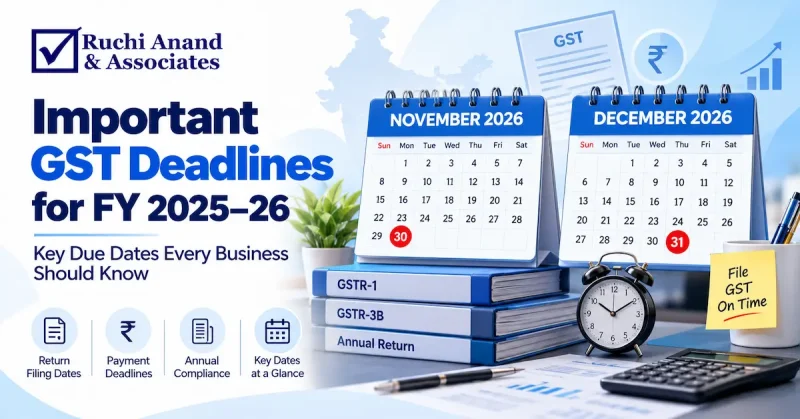
November 30 GST ITC Deadline (Section 16(4)), Rule 37A Reversals & December 31 GSTR-9/9C Checklist for FY 2025–26
Under Section 16(4) of the CGST Act, November 30, 2026 is the final statutory deadline to claim missed FY 2025–26 Input Tax Credit (ITC), declare credit notes under Section 34(2), amend GSTR-1 invoice errors, and execute mandatory Rule 37A ITC reversals before filing Form GSTR-9 and GSTR-9C by December 31, 2026.
Every year around late October, the same scene plays out across finance departments in Delhi NCR and across India. Your statutory income tax audit is barely behind you, festival holidays are wrapping up, and your accounts team is rushing to close the October monthly GST returns.
Then, twelve months later, an automated Form GST ASMT-10 scrutiny notice or a DRC-01A pre-show-cause intimation lands in your portal inbox. The problem almost always traces back to a single 30-day window: what your team did—or forgot to do—between October 20 and November 30.
In GST compliance, December 31, 2026 may be the official due date for filing your FY 2025–26 Annual Return (Form GSTR-9) and Self-Certified Reconciliation Statement (Form GSTR-9C), but November 30, 2026 is when your substantive tax rights for FY 2025–26 actually lock. You cannot claim fresh Input Tax Credit through GSTR-9. You cannot issue a backdated GST tax credit note in GSTR-9. By the time your team sits down in mid-December to compile the annual return, GSTR-9 is merely a mirror reflecting what you already locked into your monthly GSTR-1 and GSTR-3B returns up to November 30.
Here is our complete, practitioner-led playbook for CFOs, Finance Controllers, and tax leads to close FY 2025–26 cleanly before the November 30 statutory gate shuts.
1. The “November 30” Illusion: Why November 20 Is Your Real Practical Cutoff
Let’s clear up the single biggest misconception in corporate GST compliance.
Following the Finance Act, 2022 amendment to Section 16(4) of the Central Goods and Services Tax (CGST) Act, 2017, a registered person is barred from taking Input Tax Credit in respect of any invoice or debit note for the supply of goods or services after:
- The 30th day of November following the end of the financial year to which such invoice or debit note pertains, OR
- The date of furnishing of the relevant annual return (Form GSTR-9), whichever is earlier.
Why did the legislature replace the old “due date of furnishing the return for the month of September” wording with a hard calendar date of November 30? Because under the old law, if a taxpayer filed their September GSTR-3B two days late on October 22, field officers routinely issued notices disallowing the entire delayed ITC claim.
However, Section 16(4) does not create a special “November 30 return.” You can only claim ITC through a valid Form GSTR-3B.
- For regular monthly filers, the last GSTR-3B return whose due date falls on or before November 30, 2026 is the October 2026 GSTR-3B (due on November 20, 2026).
- If you miss claiming an FY 2025–26 invoice in your October 2026 GSTR-3B (or if you file your October GSTR-3B belatedly on December 1, 2026), that credit is permanently time-barred. Attempting to claim an FY 2025–26 invoice in your November 2026 GSTR-3B (filed in December 2026) will trigger an immediate automated mismatch under Section 16(4).
- Furthermore, for an omitted FY 2025–26 B2B invoice to appear in your October 2026 GSTR-2B (which generates on November 14, 2026), your vendor must report that invoice or amend it in their October 2026 GSTR-1 by November 11, 2026 (or via GSTR-1A before filing their GSTR-3B).
The 2026 Countdown Timeline for FY 2025–26 Transactions
| Statutory Milestone | Exact Cutoff Date | Operational Impact for Finance Teams |
| Vendor GSTR-1 Filing (Oct 2026 Period) | November 11, 2026 | Last practical window for vendors to upload unrecorded FY 2025–26 B2B invoices, debit notes, or B2B amendments so they populate your October GSTR-2B cleanly. |
| October 2026 GSTR-2B Generation & IMS Cutoff | November 14, 2026 | System generates October GSTR-2B. Any FY 2025–26 invoices sitting as “Pending” in the Invoice Management System (IMS) must be accepted and GSTR-2B recomputed before filing October GSTR-3B. |
| October 2026 GSTR-3B Due Date | November 20, 2026 | Standard due date to claim all residual FY 2025–26 ITC, reverse unpaid vendor credits, and execute mandatory Rule 37A reversals without late fees. |
| Absolute Statutory Cutoff (Section 16(4) & 34(2)) | November 30, 2026 | Final legal date by which the October 2026 GSTR-3B must actually be furnished to preserve FY 2025–26 ITC claims and avoid 18% p.a. Rule 37A interest. Pending FY 2025–26 records in IMS expire after this date. |
| FY 2025–26 GSTR-9 & GSTR-9C Filing Deadline | December 31, 2026 | Final statutory date to file the Annual Return (Turnover > ₹2 Cr) and Self-Certified Reconciliation Statement (Turnover > ₹5 Cr) for FY 2025–26. |
2. Four Actions Every CFO Must Complete in the October 2026 GSTR-3B
Before your tax team hits “Submit” on the October 2026 GSTR-3B, run a four-way diagnostic across your purchase registers, sales ledgers, and the GST portal.
Action 1: Sweep Unclaimed FY 2025–26 Invoices & Clear the IMS “Pending” Queue
Since the rollout of the Invoice Management System (IMS) on the GST portal, how an invoice lands in your GSTR-2B has fundamentally changed. While GSTN advisories state that taking action on IMS is “optional” because untouched invoices are Deemed Accepted on the 14th of the month, relying on “deemed acceptance” during the year-end cutoff is dangerous for two reasons:
- The “Kept Pending” Trap: Throughout FY 2025–26, your accounts payable team may have marked dozens of vendor invoices as “Pending” on the IMS dashboard because goods were in transit at year-end, quality checks were ongoing, or there was a rate dispute. Under Section 16(4), any FY 2025–26 invoice still sitting in the IMS “Pending” bucket after November 30, 2026 is permanently purged from claimability. Your team must audit the IMS dashboard right now, accept every valid FY 2025–26 pending invoice where goods/services have been received, and click “Recompute GSTR-2B” prior to filing the October GSTR-3B.
- Orphan Invoices in Your ERP: Run a line-by-line reconciliation between your audited FY 2025–26 Purchase Register (April 1, 2025 to March 31, 2026) and your cumulative GSTR-2B downloads from April 2025 to September 2026. If an expense was accrued or booked during the statutory audit in August/September 2026—such as year-end consulting bills, March logistics invoices, or repair bills—verify whether the ITC was actually taken in GSTR-3B.
Action 2: Check Reverse Charge (RCM) Self-Invoices Under CBIC Circular 211/05/2024-GST
During statutory financial audits, auditors routinely flag expenses belonging to FY 2025–26 where Reverse Charge Mechanism (RCM) was missed—most commonly on legal fees, security services, director sitting fees, GTA freight, or Import of Services (such as foreign SaaS subscriptions, cloud hosting, or overseas marketing consultants).
How does the November 30 Section 16(4) deadline apply when you pay FY 2025–26 RCM tax late in October or November 2026? The answer depends entirely on whether the supplier is registered or unregistered, as clarified by CBIC Circular No. 211/05/2024-GST:
- RCM on Supplies from Registered Persons (e.g., Registered GTA or Security Agency): The relevant document for claiming ITC is the supplier’s tax invoice. Because that invoice is dated in FY 2025–26, you must discharge the RCM liability in cash and claim the corresponding ITC on or before November 30, 2026. If you pay the RCM in December 2026, you still have to pay the tax and 18% interest in cash, but you lose the ITC forever.
- RCM on Supplies from Unregistered Persons (Including Foreign SaaS/Import of Services under Section 31(3)(f)): Here, the recipient is statutorily required to issue a Self-Invoice under Section 31(3)(f) read with Rule 36(1)(b). CBIC Circular 211 clarified that the Section 16(4) clock runs from the financial year in which the recipient issues the self-invoice, not the year of the underlying supply! Therefore, if you discover an unpaid FY 2025–26 foreign software invoice today, raise the self-invoice in October 2026, pay the RCM in cash (with applicable Section 50 interest for delayed tax payment), and you can legitimately claim the ITC in your October 2026 GSTR-3B without any Section 16(4) bar.
Action 3: Issue FY 2025–26 Credit Notes (Section 34(2)) & Amend Outward GSTR-1 Errors
November 30 is not just an ITC deadline; it is also the final cutoff for outward tax adjustments pertaining to FY 2025–26:
- GST Credit Notes (Section 34(2)): If you offered post-sale turnover discounts, accepted sales returns, or renegotiated invoice values in respect of FY 2025–26 tax invoices, any GST Credit Note that reduces your tax liability must be declared in your GSTR-1/GSTR-3B on or before November 30, 2026. If you issue a credit note after November 30 for an FY 2025–26 invoice, you can only issue a commercial/financial credit note without GST—meaning you absorb the 18% tax cost out of your own margin. ( remember also that via the IMS portal, if your corporate customer rejects your GST credit note, your tax liability is added back!).
- B2B Invoice Amendments (Table 9A of GSTR-1): Did a customer call you last week complaining that an invoice you issued in January 2026 had the wrong GSTIN, was erroneously reported as B2C instead of B2B, or carried the wrong Place of Supply? Your October 2026 GSTR-1 (due November 11, 2026) is your last clean opportunity to amend FY 2025–26 invoices so your customer doesn’t penalize you or hold back your commercial payment.
Action 4: Execute Rule 37 (180-Day Buyer Default) and Rule 37A (Supplier Default) Reversals
Mixing up Rule 37 and Rule 37A is one of the fastest ways to trigger an audit demand. Both rules govern temporary ITC reversals, both allow unlimited re-claims in future years without a Section 16(4) time bar, and both now feed into the portal’s Electronic Credit Reversal and Re-claimed Statement (ECRRS)—which we covered in detail in our recent alert on GSTR-3B blocking and the new Electronic Credit Reversal check. However, their triggers and interest traps are completely different.
3. Deep Dive: Rule 37A vs. Rule 37 — How to Avoid the 18% Interest Trap
Let’s break down the exact legal and mathematical mechanics of both rules so your team doesn’t over-reverse or miss the November 30 interest-free window.
| Compliance Parameter | Rule 37 (Buyer Payment Default) | Rule 37A (Supplier GSTR-3B Filing Default) |
| Governing Statutory Provision | Second Proviso to Section 16(2) of CGST Act | Section 16(2)(c) read with Rule 37A (Inserted via Notification 26/2022-CT) |
| What Triggers the Reversal? | You (the buyer) failed to pay the supplier the full invoice value + GST within 180 days from the date of the tax invoice. | Your supplier uploaded the invoice in GSTR-1/IFF (so it appeared in your GSTR-2B and you claimed ITC), but failed to file their corresponding GSTR-3B up to September 30, 2026. |
| When Must You Reverse the ITC? | Immediately in the GSTR-3B of the tax period following the expiry of the 180-day window. | On or before November 30, 2026 (in the October 2026 GSTR-3B) for any FY 2025–26 invoice where the vendor still hasn’t filed GSTR-3B by September 30, 2026. |
| Where to Reverse in GSTR-3B? | Table 4(B)(2) (Others — Temporary Reversal). Tracked in the ECRRS ledger. | Table 4(B)(2) (Others — Temporary Reversal). Tracked in the ECRRS ledger. |
| Interest Liability (Section 50 @ 18% p.a.) | Immediate: Interest at 18% p.a. applies from the date of utilization of that credit until the date of reversal/payment. | Interest-Free Grace Window until Nov 30: If you reverse the credit on or before November 30, 2026, ₹0 interest applies! If you fail to reverse by Nov 30, 18% p.a. interest applies from the original date of utilization. |
| When Can You Re-Claim the ITC? | In the month you actually pay the vendor (reported in Table 4(A)(5) & Table 4(D)(1) of GSTR-3B). Section 16(4) time limit does not apply to re-claims. | In the month the defaulting supplier subsequently files their pending GSTR-3B return (reported in Table 4(A)(5) & Table 4(D)(1)). Section 16(4) time limit does not apply. |
Worked Case Study 1: The Rule 37A November 30 Cliff
Suppose your manufacturing unit in Okhla purchased raw materials in January 2026 with a GST component of ₹4,50,000. The vendor promptly uploaded the invoice in their January GSTR-1, it reflected in your January GSTR-2B, and you claimed and utilized the ₹4,50,000 ITC while filing your return on March 20, 2026. You even paid the vendor in full.
However, due to a cash crunch, that vendor never filed their corresponding GSTR-3B return, and as of September 30, 2026, their GSTR-3B Filing Status on the portal still shows “Not Filed.”
- Scenario A (Compliant CFO): During your October 2026 reconciliation, you check the “GSTR-3B Filing Status” column in your GSTR-2B/2A dump. You spot the default and reverse ₹4,50,000 in Table 4(B)(2) of your October 2026 GSTR-3B before November 30, 2026. Your interest cost is ₹0. When the vendor finally clears their backlog in February 2027, you re-claim the ₹4,50,000 cleanly.
- Scenario B (Missed Cutoff): Your team ignores the vendor’s GSTR-3B filing status on November 30. In March 2027 (365 days after utilization), the department flags the Rule 37A violation and forces a reversal:
By missing the November 30 window, you pay ₹81,000 in non-recoverable cash interest for a vendor’s default that could have been neutralized interest-free in October.
Worked Case Study 2: The Rule 37 Retention Money Trap
During GST audits, officers routinely ask for your Creditors Ageing Report (>180 days) as of March 31 and September 30. In construction, EPC, and IT implementation contracts, companies frequently hold back 10% to 20% of the invoice value as “Performance Retention Money” for 12 months while claiming 100% of the ITC upfront on receipt of the invoice.
Under Rule 37, if 180 days have elapsed from the invoice date and that 20% retention amount remains unpaid, you are legally required to make a proportionate reversal using the statutory formula:
For example, if you booked an engineering contractor’s invoice of ₹11,80,000 (₹10,00,000 taxable value + ₹1,80,000 GST at 18%), paid 80% (₹9,44,000), and held back 20% (₹2,36,000) beyond 180 days, you must reverse exactly ₹36,000 of ITC in Table 4(B)(2) and re-claim it in Table 4(D)(1) only when the retention money is released. (Note: Remember that RCM supplies, Schedule I deemed supplies without consideration, and Section 15(2)(b) additions are completely exempt from the 180-day Rule 37 clock).
4. How Your November 30 Actions Feed Directly Into December 31 GSTR-9 & GSTR-9C
Once the November 30 curtain falls, the focus shifts immediately to December 31, 2026—the statutory due date for filing Form GSTR-9 (mandatory for taxpayers with aggregate pan-India turnover exceeding ₹2 Crore) and Form GSTR-9C (mandatory where aggregate turnover exceeds ₹5 Crore).
If your enterprise operates across multiple states or handles complex related-party cross-charges (especially in light of the recent GST Council October 2026 reforms), engaging our comprehensive GST compliance and GSTR-9C reconciliation services early in November ensures that your October GSTR-3B entries are mapped cleanly to the annual return tables.
The New Table 8A vs. Table 8C Architecture (GSTR-2B Logic)
Over the last two filing cycles, GSTN overhauled the backend logic of Table 8 of Form GSTR-9. Earlier, Table 8A was auto-populated from dynamic Form GSTR-2A. Now, Table 8A is auto-populated strictly from Table 3(I) of static Form GSTR-2B (for domestic inward supplies, excluding imports and RCM).
Because GSTR-2B is a cutoff-based statement generated every 14th of the month, any invoice dated in FY 2025–26 (say, March 25, 2026) that your vendor uploaded late—between April 12, 2026 and November 11, 2026—appeared in your FY 2026–27 GSTR-2B. Understanding how to report these “spillover” transactions across Tables 6, 8, 12, and 13 of GSTR-9 is the single most critical skill in avoiding an automated Table 8D negative mismatch notice.
The 5 Golden Scenarios for GSTR-9 Spillover Reporting (FY 2025–26)
| Transaction Scenario | Where It Appears on Portal | How to Report in FY 2025–26 GSTR-9 | How to Report in Next Year’s (FY 2026–27) GSTR-9 |
| Scenario 1: Vendor uploaded FY 25–26 invoice after March 2026 (up to Oct 2026 GSTR-1) & you claimed it before Nov 30, 2026 | Reflects in GSTR-2B of FY 2026–27 (Apr–Oct 2026) and updated in Table 8A logic. | Do not include in Table 6B (which is strictly for ITC availed in FY 25–26 GSTR-3Bs). Report in Table 8C and Table 13. | Report in Table 6A1 (ITC of preceding FY availed in current FY) so it doesn’t distort next year’s Table 6B/8B check. |
| Scenario 2: Invoice dated FY 25–26 appeared in March 2026 GSTR-2B, but goods arrived in April 2026 (Circular 170 Temporary Reversal) | Appeared in FY 2025–26 Table 8A (March 2026 GSTR-2B), claimed/reclaimed in April 2026 GSTR-3B. | Report the April 2026 claim in Table 8C and Table 13 of FY 2025–26 GSTR-9. | Report in Table 6A1 of FY 2026–27 GSTR-9. |
| Scenario 3: ITC of FY 25–26 reversed under Rule 37 (180 days) or Rule 37A in FY 25–26, and re-claimed in FY 2026–27 | Already counted in original year’s Table 8A. Reclaimed via Table 4(D)(1) in FY 26–27. | Report the reversal in Table 7A (Rule 37) or Table 7A1 (Rule 37A) of FY 25–26. Do NOT report the re-claim in Table 8C or Table 13 of FY 25–26! | Report the re-claimed ITC in Table 6H of FY 2026–27 GSTR-9 (which is delinked from Table 8B to prevent double counting). |
| Scenario 4: ITC on Import of Goods or RCM pertaining to FY 25–26 availed between April and October 2026 | Excluded from Table 8A (which only covers domestic 2B supplies). Imports tracked in Table 8G/8H/8H1. | Report RCM/Import spillover in Table 13 (and Import IGST availed in next FY in Table 8H1), never in Table 8C (Table 8C is strictly for domestic inward supplies). | Report in respective RCM/Import rows (Table 6C/6D/6E) in the year of availment with proper reconciliation notes in GSTR-9C Table 12. |
| Scenario 5: Outward B2B Sales Invoice or Credit Note of FY 25–26 declared/amended between April and October 2026 | Reported in GSTR-1 & GSTR-3B of Apr–Oct 2026. | Report additions in Table 10 and reductions/credit notes in Table 11 of FY 2025–26 GSTR-9 (and reconcile in Table 5/7 of GSTR-9C). | Exclude from FY 2026–27 turnover in GSTR-9C Table 5 adjustments to avoid double taxation. |
Worked Example: How Table 8 Reconciliation Should Balance
Suppose for FY 2025–26, your company’s Table 8A (auto-populated from GSTR-2B) shows ₹1,20,00,000 of eligible domestic ITC.
- During April 2025 – March 2026, you availed ₹1,12,00,000 in your FY 2025–26 GSTR-3B returns (which populates Table 8B from Table 6B).
- Between April 2026 and your October 2026 GSTR-3B (filed before November 30, 2026), you availed the remaining ₹6,50,000 of FY 2025–26 invoices that arrived late in April or were cleared from the IMS pending queue. You report this ₹6,50,000 in Table 8C (and Table 13).
- The system calculates Table 8D as:
Because Table 8D is positive (+₹1,50,000)—representing blocked Section 17(5) credits (like employee food/beverages or motor vehicle repairs) that appeared in GSTR-2B but you rightly chose not to claim—you report ₹1,50,000 in Table 8E (ITC available but not availed), and your return passes automated scrutiny with zero risk. Conversely, if you forget to populate Table 8C, or if you accidentally include Import/RCM credits in Table 8B/8C, Table 8D turns negative and triggers an automated scrutiny flag.
5. Common Red Flags That Trigger ASMT-10 Scrutiny & GST Audits
Having represented hundreds of corporate taxpayers across Delhi NCR—from fast-scaling D2C startups to multi-state manufacturing plants—we see the exact same five reconciliation gaps trigger departmental notices every year. As we highlighted in our departmental GST audit defense guide, departmental officers don’t start an audit by reading your vouchers; they run automated ratio checks across your GSTR-9, GSTR-9C, Form 26AS/AIS, and Audited Financial Statements.
- Unreconciled Deferred Revenue & Unbilled Revenue (GSTR-9C Table 5B & 5O): Under Ind AS / AS-9, your audited Profit & Loss statement recognizes revenue on an accrual/milestone basis, whereas GST is triggered by the Time of Supply (invoice date or receipt of advance for services under Section 13). If you don’t maintain a granular working sheet reconciling opening/closing unbilled revenue and customer advances in Table 5 of GSTR-9C, the officer will treat the entire P&L-to-GSTR-1 variance as suppressed turnover.
- Sale of Fixed Assets (Motor Cars, Old Machinery, Scrap) Missing from GSTR-1: When your accounts team sells an old factory machine or company car during FY 2025–26, they record the deletion in the Fixed Asset Schedule of the Balance Sheet and book only the net profit or loss in the P&L. GST officers routinely inspect the Fixed Asset Schedule in your audited balance sheet and demand 18% GST (or Section 18(6) capital goods ITC reversal) on asset disposals that were never reported in GSTR-1/GSTR-3B.
- Rule 42 & Rule 43 Common Credit Reversal Omissions: Did your company earn exempt income during FY 2025–26, had sale of land/building, or traded in securities (where 1% of the sale value of securities is deemed exempt turnover under Section 17(3))? Remember that Rule 42 mandates an annual recalculation of common ITC reversal for the entire financial year before the November 30 / September return cutoff. Any short reversal must be paid along with 18% interest from April 1, 2026!
- Director Remuneration & Related-Party Cross-Charges (Schedule I): Officers cross-check the Related Party Disclosures (AS-18 / Ind AS 24) in your audited financials against your RCM filings. Ensure that whole-time director salaries (subject to TDS under Section 192 / new Income-tax Act provisions) are clearly bifurcated from independent director sitting fees or professional commissions (which attract 18% GST under RCM per CBIC Circular 140/10/2020-GST).
- E-Way Bill vs. GSTR-1 Outward Turnover Mismatches: Before filing GSTR-9, download your annual E-Way Bill outward report from the EWB portal and reconcile it against Table 4 of GSTR-9. Any active E-Way Bill generated in FY 2025–26 that wasn’t cancelled within 24 hours—even if the delivery truck broke down or the order was cancelled—will be presumed by the department to be an unaccounted clandestine supply unless backed by contemporaneous cancellation proof and gate-entry logs.
6. The Ultimate 12-Point CFO Checklist for Nov 30 & Dec 31, 2026
Use this sequential execution checklist with your tax and accounting teams over the next four weeks:
- Run Pan-India Purchase Register vs. GSTR-2B Reco (Apr 2025 – Sept 2026): Identify every FY 2025–26 vendor invoice recorded in your books where ITC has not yet been claimed in GSTR-3B.
- Follow Up With Defaulting Vendors Before Nov 11: Send automated debit-note warnings to vendors who haven’t reported FY 2025–26 invoices in GSTR-1 so they upload them by November 11, 2026.
- Clear the IMS “Pending” Queue by Nov 14: Review all FY 2025–26 invoices sitting as “Pending” in the GST portal Invoice Management System, accept eligible records, and recompute the October GSTR-2B.
- Verify Vendor GSTR-3B Filing Status for Rule 37A: Filter your FY 2025–26 GSTR-2B/2A dump for suppliers whose GSTR-3B status is still “Not Filed” as of September 30, 2026, and reverse that ITC in Table 4(B)(2) of the October 2026 GSTR-3B to save 18% interest.
- Audit the >180-Day Creditors Ageing Report (Rule 37): Identify non-MSME vendor bills and retention money from FY 2025–26 unpaid beyond 180 days and execute proportionate reversals.
- Execute Annual Rule 42/43 Common Credit True-Up: Recompute annual common ITC apportionment if your business had any exempt supplies during FY 2025–26.
- Issue All Pending FY 2025–26 Credit Notes & B2B Amendments: Declare all post-sale discount credit notes and B2B GSTIN/POS corrections in the October 2026 GSTR-1/3B before November 30, 2026.
- Conduct an Expense Ledger Scrub for Missed RCM: Check Legal, Security, GTA Freight, Sponsorship, Director Sitting Fees, and Foreign Software/Marketing ledgers; raise Section 31(3)(f) self-invoices and discharge RCM in cash to claim ITC before the cutoff.
- Write Off Time-Barred ITC in Books: Any FY 2025–26 ITC that remains unclaimable after November 30, 2026 due to vendor non-compliance must be charged off to the P&L or recovered commercially from the vendor’s retention balance.
- Map Spillover Transactions to GSTR-9 Tables 6A1, 8C, 10, 11, 12 & 13: Tag every FY 2025–26 transaction adjusted between April 2026 and October 2026 in a dedicated working file so Tables 8C and 13 match to the rupee.
- Reconcile Audited Financials to GST Returns (GSTR-9C Table 5, 9 & 12): Prepare GSTIN-wise trial balances (if you hold multiple state registrations under the same PAN) and reconcile inter-branch cross-charges, fixed asset sales, and unbilled revenue.
- File GSTR-9 and GSTR-9C Well Before December 31, 2026: Avoid last-week portal bottlenecks and review Form DRC-03 voluntary payment calculations carefully if any short tax or RCM liability is identified during reconciliation.
Need a Second Pair of Expert Eyes Before the November 30 Cutoff?
Once the October 2026 GSTR-3B is filed and November 30 passes, any unclaimed FY 2025–26 Input Tax Credit or unreversed Rule 37A liability turns into a permanent cash cost on your balance sheet.
At Ruchi Anand & Associates (RAAAS), our Delhi NCR indirect tax team and Virtual CFO advisory specialists work alongside corporate finance teams to execute automated, line-by-line GSTR-2B vs. Purchase Register reconciliations, vendor default screenings, and multi-state GSTR-9/9C sign-offs.
Schedule a Pre-Filing GST & GSTR-9C Health Check with RAAAS Today →