
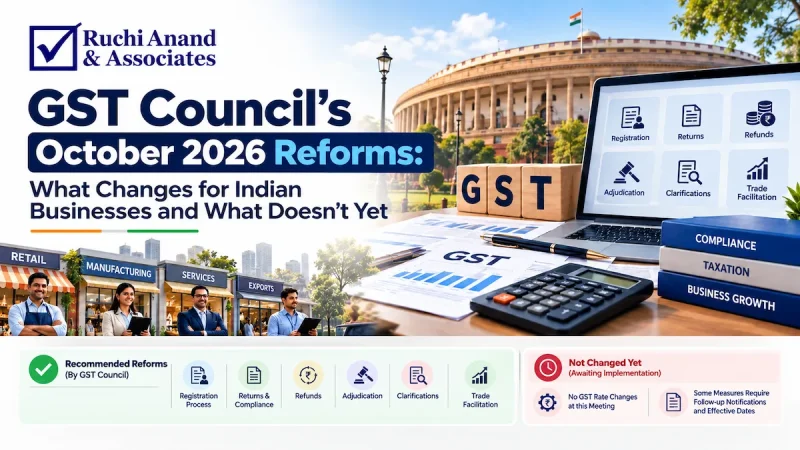
GST Council’s October 2026 Reforms: What Changes for Indian Businesses and What Doesn’t Yet
GST Council’s October 2026 Reforms: What Changes for Indian Businesses and What Doesn’t Yet
The 56th GST Council meeting, in September 2025, was about rates. The 57th, held in New Delhi on 8 October 2026, was about something finance teams feel more often: how the tax is administered day to day. Registration, returns, refunds, notices, arrest, prosecution and the stopping of trucks on the road all came up.
The Council’s recommendations are not law. As the Press Information Bureau’s own release on the meeting points out, they take effect only through circulars, notifications and amendments to the Acts and rules. Until those are issued, the current provisions apply. Keep that in mind through everything below, and keep filing on the existing rules.
The changes that affect cash first
For most businesses the refund and credit measures matter more than anything else in the package.
Automated refunds.
The Council wants refunds on excess cash-ledger balance, zero-rated supplies and inverted duty structure processed by the system, in two phases. In the first phase, the full excess cash-ledger balance is refunded automatically. For zero-rated and inverted-duty claims, 90% of the amount claimed is sanctioned provisionally by the system, based on its risk assessment, without an officer. The time to acknowledge an application or issue a deficiency memo drops from 15 days to 10, and silence after 10 days counts as acknowledgement. The second phase moves acknowledgement and full sanction of zero-rated refunds to the system too.
Fewer refund irritants for exporters.
The cap that limited zero-rated turnover of goods to 1.5 times the value of like goods supplied domestically (Rule 89(4)(C)) is to go. The ₹1,000 minimum refund will be tested against CGST, SGST/UTGST and IGST taken together, not head by head. The refund form will capture data in a system-readable format, so scanned documents will no longer be needed for zero-rated and inverted-duty claims.
Accumulated ITC refunds widen.
Today an inverted-duty refund covers credit on inputs only. The Council recommends extending it to input services (credit availed on or after 1 November 2026) and capital goods. Capital goods credit, for both zero-rated and inverted-duty refunds, would be refunded over 60 months and only for credit availed on or after 1 April 2027. If you buy plant and machinery, the 60-month spread means this helps your cash flow slowly, not at once.
Blocked credit under Section 17(5) loosens. Restrictions would be removed on outdoor catering, health and life insurance, telecommunication towers, pipelines laid outside factory premises, free samples, and goods destroyed or written off on expiry of shelf life as required by law. The PIB wording says “inter alia”, so the final list may differ. Separately, limited same-line-of-business credit is proposed for restaurant and outdoor catering services, hotel accommodation up to ₹7,500 per unit per day, and gym and fitness services.
A plain warning about forecasting: none of this is cash until the law changes, the claim is filed and the system or officer processes it. Keep recommended refunds out of your cash-flow projections.
Returns: the one change that will alter month-end work
The Council has recommended a new mechanism to correct liability and ITC inside the return system itself, aimed at the mismatches that generate most routine notices. It adds a Rule 86D statement of tax paid on reverse charge and credit claimed, a Rule 86C statement of ITC reversed and reclaimed, formal rules for the Invoice Management System (accept, reject or keep pending), and correction routes in Rule 61 so that GSTR-3B can be aligned with GSTR-1/1A/IFF on liability and with GSTR-2B on credit.
This one has a concrete date. The Council recommends it apply from the return for April 2027, and it will first go out for time-bound public consultation, with the Finance Minister authorised to approve changes after feedback.
If your purchase register, GSTR-2B and books don’t reconcile invoice by invoice today, fixing that is the best preparation. A mechanism for correcting mismatches won’t help a company that can’t identify them.
Also in this group: a late-fee waiver on returns under Section 39(1) for taxpayers with turnover up to ₹5 crore in the preceding year, if the return is filed by the end of the month it was due. E-invoicing is to extend to inward supplies from unregistered persons under reverse charge and to imports of services, for businesses with turnover of ₹5 crore and above, so those taxpayers should check their systems.
Notices, penalties and disputes
The package is more detailed here than the headline penalty cut suggests.
- No show-cause notice under Sections 73, 74 or 74A where the tax involved is below ₹10,000 (CGST, SGST, IGST and cess together). Pending notices and appeals below that figure would be decided as if the threshold had always applied.
- In non-fraud cases, a reduced penalty of 5% if tax and interest are paid within 30 days (Section 73) or 60 days (Section 74A) of the adjudication order, and no minimum penalty of ₹10,000.
- The general penalty under Section 125 cut from ₹25,000 to ₹10,000. That is the residual penalty for contraventions with no specific penalty, not a ceiling on every demand.
- A cap of ₹40 crore (₹20 crore each under CGST and SGST/UTGST) on pre-deposit for appeals where an order involves only penalty and no tax.
- A right to object and be heard before credit is blocked under Rule 86A.
- A circular telling officers how to issue notices and orders, including invoking fraud or suppression only where the facts support it.
One recommendation points the other way, and it deserves more attention than it has had. The Council also recommended a validation clause for notices that courts have held invalid because one notice covered several financial years. Taxpayers who have won on that ground should watch how it is drafted, since it could affect pending litigation.
Arrest and prosecution
The headline recommendation is the complete omission of Section 69 of the CGST Act, which removes the power to arrest under GST. The prosecution threshold would rise from ₹1 crore to ₹5 crore, the punishments under Section 132 would be rationalised, and several clauses would be narrowed. Clause (c), for example, would cover only fraudulent availment of ITC without receipt of goods or services or without an invoice or bill.
What this does not do matters as much. Demands, interest, penalties, attachment and investigation stay, and prosecution remains for larger fraud. Anyone planning to treat ITC more loosely on the strength of this recommendation would be misreading it.
Goods in transit
Under the proposed amendments to Sections 68, 129 and 130, a vehicle can be intercepted only on specific intelligence and with authorisation from an officer of at least Joint Commissioner rank. Inspection, detention or seizure would be allowed only where the supplier or the recipient is located or registered in the State doing the intercepting, with no interception in transit States. Goods moving with no e-way bill, or with no document showing origin or destination, could still be inspected, detained or seized irrespective of jurisdiction. Confiscation under Section 130 would not apply to goods in transit.
For transporters and dispatch teams the practical message is unchanged: the e-way bill and invoice must match what is actually on the vehicle. The recommendation narrows who can stop you and where, not what you must carry.
Registration
Registration reforms build on Rule 14A, under which the portal grants registration automatically where the applicant does not intend to pass on ITC above ₹2.5 lakh a month. For everyone else, the Council recommends a circular listing the required documents with FAQs, drop-down document selection in FORM GST REG-01, and a friendlier portal. Amendments to registration particulars would be accepted automatically, except for the principal place of business (which, for Rule 14A taxpayers, would also be automatic). Cancellation moves toward system acceptance in two phases once returns are filed and dues paid, and system-based cancellation and revocation is proposed for non-filing or missing bank details.
For small online sellers, a new Rule 14B would let a small supplier of goods through an e-commerce operator register in a State where it has no physical presence, by declaring the operator’s warehouse there as its principal place of business. It carries the same ₹2.5 lakh ITC condition and excludes stock transfers between distinct persons, and registration would be granted automatically subject to conditions.
Small taxpayers
An optional Annual Return Quarterly Payment (ARQP) scheme was approved in principle for taxpayers with turnover up to ₹5 crore in the preceding year who supply exclusively to unregistered persons, meaning pure B2C businesses. It is a concept note, not a scheme. The ₹5 crore turnover figure, the Rule 14B registration route and the late-fee waiver are three separate measures, and they shouldn’t be mixed up. None lets a seller stop filing returns today.
Exports and cross-border services
Four changes stand out:
- Omitting sub-clause (v) of Section 2(6) of the IGST Act, so that services supplied to or through a taxpayer’s own foreign branch can qualify as exports.
- Omitting Section 13(3)(a), so that testing, repair and similar services on goods a foreign client sends to India follow the default place-of-supply rule (the recipient’s location) and can qualify for export treatment.
- A new explanation to Section 16(1): goods delivered to an overseas buyer in an SEZ or Free Trade Warehousing Zone, with payment in convertible foreign exchange or in rupees where RBI permits, are treated as supplied to the SEZ/FTWZ.
- A circular on receipt of export proceeds in foreign exchange or rupees.
An overseas customer does not make a service an export. Recipient, place of supply and payment conditions still apply, so map your contracts against them before you change anything.
Rates: no across-the-board change
The meeting was not a rate revision, but the release does carry targeted items: an option to pay 5% with restricted ITC on passenger transport and rental with operator using electric vehicles; 5% without ITC on certain e-commerce delivery services; nil GST on psyllium seeds; reverse charge and 2% TDS on specified waste and scrap; and a handful of exemptions and classification clarifications. If your products or services are in any of these areas, read the item itself.
When these take effect
There is no single date. The only date the PIB release gives for returns is the April 2027 return for the new correction mechanism, and the dates it gives for refunds are 1 November 2026 (input services) and 1 April 2027 (capital goods), each for credit availed on or after that day. A tax commentary on the meeting reports that the Finance Minister indicated at the media briefing that most process reforms are targeted for 1 April 2027. Treat that as a signal rather than a notified date.
Before you change a system or a tax position, confirm the following for the specific measure:
- The relevant Act or rule has actually been amended
- A notification or circular has been issued
- The effective date and any transitional provisions
- Whether it applies to your type of transaction
- Whether the forms and portal functions exist
Housekeeping to do between now and April
- Reconcile. Match purchases, GSTR-2B and books invoice by invoice, and chase recurring supplier mismatches.
- File eligible refunds now. If a claim qualifies under current rules, waiting for automation only delays money you may already be owed.
- Keep a notice register with dates, deadlines, issue, owner and evidence. A missed deadline is usually how a small query turns into a large one.
- Check your registration details against your documents before filing or amending.
- Check exposure under the new ITC rules. Catering, insurance, telecom towers and free samples may become creditable once enacted. Don’t claim them early.
- Review cross-border contracts against the export conditions, especially branch arrangements and job work on foreign-owned goods.
- Name one person to track amendments, notifications and the consultation on the new return mechanism.
Where RAAAS fits
GST compliance goes beyond filing returns on time. Businesses also reconcile input tax credit, keep records that will stand up to scrutiny, answer notices, follow refund claims, and work out how each regulatory change affects their own transactions.
RAAAS provides accounting, taxation and compliance support for businesses handling these tasks, from routine GST filing to a specific compliance question. In practice that can include:
- GST compliance: return preparation, filing requirements and related documentation
- ITC reconciliation: reviewing purchase records against GST data to flag discrepancies that need attention
- Refund support: helping eligible businesses review requirements, supporting documents and claim records
- Accounting records: keeping financial information organised for reporting and tax compliance
- Regulatory updates: explaining relevant GST changes and whether your processes need revising
The right level of support depends on your size, transaction mix and existing accounting set-up, so confirm the scope of services with RAAAS before engaging. To review your current GST process ahead of these changes, see the RAAAS GST services page.
Frequently asked questions
1. Has GST arrest been abolished?
Not yet. The Council recommended omitting Section 69 of the CGST Act. Until the amendment is enacted and in force, the existing law applies.
2. Has the prosecution threshold risen to ₹5 crore?
It has been recommended. It applies only after the CGST Act is amended and the amendment commences.
3. Have GST rates changed?
There is no general change. The meeting dealt mainly with process reforms, though it recommended a few targeted rate options, exemptions and classification clarifications. Check the relevant notification for any item you deal in.
4. Can a small e-commerce seller stop filing GST returns?
No. Rule 14B concerns registration in other States through an e-commerce operator’s warehouse, and the ARQP scheme is only a concept approved in principle for pure B2C businesses. Neither is in force.
5. Should I wait for the new rules before claiming a refund?
Generally no. If the claim is eligible under the current provisions, file it. Then watch whether the new automation or wider credit rules affect later claims.
6. Will the new refund and credit changes apply to credit I already hold?
Not necessarily. The recommended dates (1 November 2026 for input services and 1 April 2027 for capital goods) apply to credit availed on or after those dates. Check the final amendment before adjusting any claim.
Conclusion
The Council has recommended a lighter, more automated and less punitive GST administration, with real money in the refund and credit changes and a narrower criminal regime. The recommendations still have to pass through amendments, rules and notifications, and at least one of them (the multi-year notice validation) cuts against taxpayers.
For now, keep filing, reconcile your credit, file refunds that are already eligible, answer every notice on time, and follow the official notifications that fix each effective date. Businesses with clean invoice-level records will be best placed to use whatever relief becomes law.