

Can the Income Tax Department Demand Your Spouse’s ITR? Deciphering the Delhi High Court’s Landmark Ruling
In the complicated world of Indian taxation, it becomes difficult to determine the extent to which an individual’s privacy is invaded or whether he is entitled to any secrecy with respect to certain documents that might be sought by an investigator or authority during investigations.
Over the years, authorities have enjoyed wide latitude while invoking their powers to call upon documents but now, after an important judgment issued by the Delhi High Court, there is clarity about how far one can go in asking for documents belonging to the other spouse.
The issue: Could the Income Tax Department compel an individual to give his/ her ITRs and financial documents pertaining to his/her husband/wife?
This important decision by the Delhi High Court has thrown up some vital information with regard to Sections 131 and Section 142(1) (These sections are a provision of the old Income Tax Act, 1961) of the Income Tax Act. Here is all you need to know.

The Genesis of the Dispute: A Privacy vs. Investigation Tug-of-War

This case usually occurs during “scrutiny assessments” or “re-assessments.” The AO, having suspicions about any unaccounted investments or transactional activities, requests the taxpayer to submit the ITRs of their spouse, thereby verifying the source of the money.
In the past, it was common practice for taxpayers to cooperate because of the threat of penalties. Nevertheless, the legal position has evolved. Delhi High Court has recently said that both the husband and wife are separate parties in regard to the Income Tax Act. Documents cannot be demanded unless it is proved that there have been “benami” transactions.
The Core of the Decision: Privacy is Paramount
Delhi High Court made it clear that:
- Identity of Individual Taxpayer: The taxpayer has his own individual identity.
- Privacy: The information contained in an ITR involves the right to privacy of the individual.
- Information of Third Party: In case the spouse’s ITR needs to be provided by the department, the powers conferred in Section 133(6) must be utilized against such person.
Legal Framework: Understanding the Provisions
In order to understand the significance of the decision, one must understand what is contained in the Income Tax Department:
1. Section 131: Powers regarding discovery, production of evidence, and so forth
(This section is a provision of the old Income Tax Act, 1961)
This section gives powers to the AO, powers akin to those given to a civil court, allowing him to summon a person and also produce “books of account and other documents.”
2. Section 142(1): Inquiry before assessment
(This section is a provision of the old Income Tax Act, 1961)
The AO can issue notices to produce “documents as the AO may require.”
Judgment of the High Court: It was held that “documents as the AO may require” means those documents belonging to the assessee only. An individual has no legal right to the income tax return (ITR) of his/her spouse or any other individual’s private bank statements.
The Rise in Scrutiny Cases
The Indian tax landscape is evolving with the introduction of “Faceless Assessment” and the “Annual Information Statement” (AIS).
| Financial Year | Number of Scrutiny Notices Issued (Estimated) | Percentage of Cases Related to High-Value Transactions |
| 2021-22 | 2,50,000+ | 45% |
| 2022-23 | 3,10,000+ | 52% |
| 2023-24 | 3,80,000+ | 60% |
According to data, the “Family Linkage” in tax evasion is the core emphasis of the department. By linking PAN cards through Aadhaar, the department’s AI systems now flag discrepancies where a spouse with low income makes high-value investments. While the department has access to all the data, the HC order of Delhi ensures that the department follows the legal due process in obtaining their documents.
Implications for High-Net-Worth Individuals (HNIs) and Business Owners
It becomes a shield for the businesspersons and high-net-worth individuals. In most cases, during an inspection or survey, the department tries to combine the earnings or assets of the family members for cross-checking.
Why this matters:
- Harassment Protection: It stops AOs from harassing the taxpayers by considering their spouses’ non-cooperation as a ground to punish them.
- Data Integrity: Encourages the department to use its own “Insight Portal” and internal data rather than placing the burden of proof on the taxpayer for third-party documents.
- Marriage Does Not Automatically Mean a Waiver of the Right to Financial Privacy: Provides for this aspect from the perspective of tax laws.
When CAN the Department Ask for a Spouse’s Details?
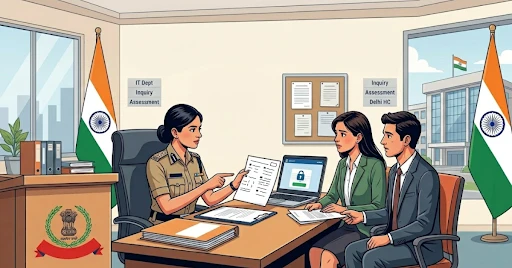
While the Delhi HC has limited the method of asking, they haven’t banned the inquiry altogether. The department can still access your husband’s or wife’s ITR if:
- Joint Assets: The property or investment in question is held jointly.
- Gift Transactions: If you claim you received a large sum of money as a gift from your spouse.
- Section 64 (Clubbing of Income): If income from assets transferred to a spouse is being clubbed with your income.
- AO Notice to Spouse: The AO gives a direct notice to the spouse through Section 133(6).
Navigating Tax Challenges in a Globalized Economy
Now as India emerges as the global focal point, it is even more important to understand the interaction between the decisions made on domestic taxes and the establishment of businesses internationally. Irrespective of whether you are an individual facing harassment or a foreign organization entering the Indian market, the understanding of the legal framework is imperative.
The decision taken by the Delhi High Court proves that although the government has all the rights to tax the citizen, he/she too has the right of privacy. In the current world, which is fast moving towards a digital economy, this judicial balance ensures that not only Ease of Doing Business, but also Ease of Living prevails among honest citizens.
Conclusion: Setting the Standard for Compliance
In summary, this judgment by the Delhi High Court provides an important precedent and makes it clear that the Income Tax Department has to function under the constraints of constitutional and statutory powers. This also protects the privacy rights of the individual, and places the responsibility of carrying out the investigation on the government officials and not on the relatives of the taxpayer.
RAAAS understands that, no matter if you are a local tax payer or an international corporation looking for a comprehensive India Entry Strategy, the nuances involved in setting up a foreign entity in India demand due diligence. With experts in Foreign Company Incorporation in India and Company Setup Advisory in India, RAAAS can assure you that your business adheres to all the rules from the start itself. Our premium Tax Advisory Services cover both individuals and businesses and will take you through the complexities explained in the blog above. As your business grows, our services extend to Company Establishment in India and Foreign Company Registration in India, covering all the legal requirements. Further, our company offers the technical support that every business needs in today’s world through SAP outsourcing and startup-oriented Accounts Outsourcing services, enabling entrepreneurs to focus on scaling their business while we handle Foreign Company Incorporation in India and other tax matters.