
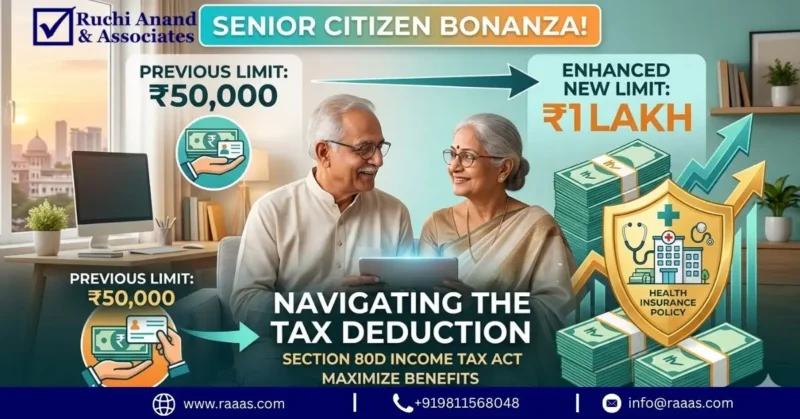
Senior Citizen Bonanza: Navigating the Enhanced ₹1 Lakh Tax Deduction Limit
There seems to be a drastic transformation occurring in the world of Indian taxation systems, especially concerning one generation that has been instrumental in building up this country for decades – the senior citizens of India. In a step that recognizes and honors the older generations while considering the growing expense of medical facilities, the government has increased the limit on deductions. While before, this was capped at ₹50,000, it now stands at an impressive ₹1 Lakh, which may be called a Senior Citizen Bonanza
We feel that an appreciation for these shifts will be crucial to successful wealth preservation. This definitive guide analyzes the complexities of these new deduction ceilings, the socio-economic forces driving them, and how the silver generation can optimize their post-retirement gains.

The Shift: From ₹50,000 to ₹1 Lakh
Section 80D of the Income Tax Act was the principal cover for senior citizens to save themselves from the heavy cost burden of health insurance premiums and health check-up expenses. Traditionally, the ceiling amount for senior citizens (above 60 years of age) was fixed at ₹50,000. But understanding that the cost of medical services would be inflated owing to higher life expectancy, the threshold limit is doubled to ₹1 Lakh in some cases.
Breaking Down the Components
“₹1 Lakh” is generally a compilation of several sub-sections. The main components include:
- Medical Insurance Premiums: Payments made for health insurance coverage.
- Medical Expenditure: For extremely elderly individuals (over 80 years old) or persons not covered by health insurance, real expenditure incurred on health can now be included.
- Preventive Health Check-ups: A small but important component for remaining healthy.
Why the Change Matters: A Data-Driven Perspective
One must consider the reasons for this boom by examining the high medical inflation in India. The medical inflation rate in India is always higher than that of general inflation, usually ranging from 10 to 14 percent per year.
Real-Time Data Comparison
| Category | Average Cost (2018) | Average Cost (2024 – Projected) | Inflation Impact |
| Critical Illness Insurance | ₹22,000 | ₹38,000 | ~72% Increase |
| Annual Hospitalization (Avg) | ₹45,000 | ₹85,000 | ~88% Increase |
| Diagnostic Tests | ₹5,000 | ₹9,500 | ~90% Increase |
However, for someone who is retired and lives off a fixed pension or interest income, such high expenses can drain away their life’s savings in no time. By increasing the tax deduction to ₹1 Lakh, the government enables the senior citizen, who pays tax at a rate of 30%, to save an extra ₹15,000.

Maximizing the Benefits: Strategic Financial Planning
Knowing that there is a limit is not sufficient; rather, one should be able to know how to fund themselves up to the limit.
1. The Power of Section 80D
Under the revised norms, if you are a senior citizen paying for your own insurance, you can claim up to ₹50,000. However, the “Bonanza” truly kicks in for the “Sandwich Generation”—individuals who are paying for their own insurance (limit ₹25k-50k) AND for their senior citizen parents (limit ₹50k). When combined, the family unit can see a total deduction of up to ₹1 Lakh.
2. Medical Expenditure for the Uninsured
Many elderly citizens find it difficult to obtain new insurance policies due to pre-existing conditions or high age. The new provisions allow for the deduction of actual medical expenditure (consultations, medicines, etc.) For senior citizens up to ₹50,000 if they don’t have a health insurance policy. It is a breakthrough for people who did not get any tax benefit on their medical expenses before.
The Economic Ripple Effect
By placing additional financial resources into the pockets of senior citizens, the government will have stimulated a particular segment of the economy. The additional disposable income enjoyed by seniors may translate into increased spending in the wellness, tourism, and “silver economy” sectors.
Moreover, this step will push the young generation to be accountable for the health of their parents. If a young working professional gets to see a monetary gain from this tax cut (₹50,000 deduction for covering the premium of one’s parents), then they will make sure that their parents have insurance coverage.
Common Myths vs. Reality

- Myth: “₹1 Lakh limit applies to all.”
- Reality: ₹1 Lakh is the cumulative limit, which applies in most cases if the person himself and his parents are senior citizens or by availing of Sections 80D and 80DDB together for certain ailments.
- Myth: “No need to have receipts for medical expenses.”
- Reality: Payments made digitally along with the saved prescriptions become necessary. Even though the procedure is simplified, there must be paperwork at the Income Tax Department’s end.
Future Outlook: Planning for 2025 and Beyond
With the evolution of the country into a more digitized and organized nation, we can foresee more improvements to tax brackets. In the case of senior citizens, we recommend continuing with the following:
- Diversifying Portfolios: Combining SCSS investments with debt fund investments.
- Documentation: Maintaining online documentation for all medical expenses to ensure you get the maximum ₹1 Lakh deduction.
- Professional Advisory: Tax policies are dynamic. Consulting with professionals will not only make sure you follow them, but also help you optimize your tax payments.
Conclusion: A Step Toward Financial Dignity
The raising of the threshold amount to ₹1 Lakh is not just a fiscal move but an acknowledgment of the difficulty in managing finances towards the end stage of life. This allows older people to be able to avail themselves of good medical treatment without worrying about losing money through taxation. At RAAAS, we are here to help you with such issues.
As the economy of India continues to gain more international interest, there is a corresponding demand for well-designed systems for corporations and individuals to manage their finances. Individuals looking into the bigger picture have to understand the country’s tax system. This is especially true for those who have a need to establish a Foreign Entity in India or Foreign Company Incorporation in India. In addition to our expertise in personal taxes, we are able to give professional advice in regards to the Company Setup Advisory in India, allowing foreign entities to integrate seamlessly into the Indian economy. We offer the best tax advisory services available in the market, tailored for individuals and companies. Whether you are preparing a business plan for an entry into the country with an India Entry Strategy or planning to outsource SAP functions with an SAP Outsourcing plan, our company is ready to help. We handle the Accounts Outsourcing for Startups and Company Establishment in India. We take pride in being able to guide our clients through all the steps, starting from the Registration of Foreign Companies in India to Foreign Company Incorporation in India.