
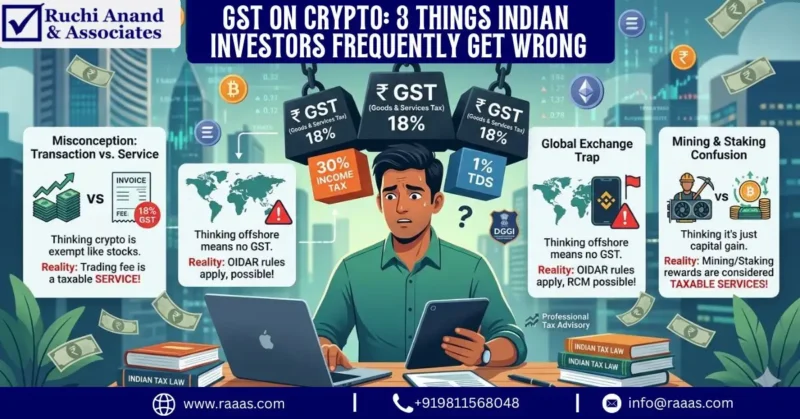
GST on Crypto: 3 Things Indian Investors Frequently Get Wrong
There have been many changes in the landscape of Virtual Digital Assets (VDAs) in India over recent years. As most of the news continues to focus on the 30% flat income tax as well as the 1% Tax Deducted at Source (TDS), there is a hidden and rather complex monster that is not getting enough coverage: the Goods and Services Tax (GST).
To the everyday Indian cryptocurrency trader, GST is a forgotten term; it is something that they think the exchange will take care of. But, as the Directorate General of GST Intelligence (DGGI) steps up their investigations against crypto exchanges and affluent people, being unaware of GST rules can be dangerous.
Ruchi Anand & Associates is an expert in handling the maze of taxes in India. This blog helps us understand the three biggest myths regarding the GST levy applicable to cryptocurrencies among most Indian investors. It also offers an elaboration on how to be GST-compliant in crypto transactions.
1. The Transaction vs. Service Confusion: Is Crypto a Good or a Service?

The main problem that investors make is thinking that because they pay 30% of Income Tax on the profit, there won’t be any GST levied on the trading.
The Misconception:
Investors have a misconception that acquiring Bitcoin is akin to acquiring stocks. Since securities do not fall within the ambit of “Goods” and “Services,” investors assume cryptocurrencies will be exempt.
The Reality:
Under the Indian law, the classification of crypto assets as per now is Virtual Digital Assets (VDAs). Unlike shares or any other traditional asset, for instance, fiat money, the facilitation of trading these crypto assets is considered a taxable service under GST.
GST in India is imposed only on the service fee/commission levied by exchanges (generally 18%). Nevertheless, now it is discussed by the GST Council members whether the full amount of trading should be subjected to taxes or whether only the margin would have to be taxed.
As an ordinary investor, you will have to pay 18% GST on the trade as a trading fee tax. Nevertheless, if you are a trader who trades cryptocurrencies as a business – an arbitrageur or a High-Frequency Trader, then the uncertainty about the nature of crypto – good or service – might complicate your ITC utilization.
2. The Global Exchange Trap: “Offshore Means No GST”
Investors in large numbers have transferred their investments overseas into foreign exchanges such as Binance, Bybit, or KuCoin following the introduction of the 1% TDS on transactions post-trade in India in a bid to escape from taxes levied by the Indian government.
The Misconception:
Since the trading takes place in Seychelles/BVI, one would think there is no requirement for the payment of GST.
The Reality:

As per the provisions of the GST Act, specifically the OIDAR (Online Information Database Access and Retrieval) services, GST needs to be levied by the foreign service provider to a non-registered individual in India.
Moreover, if an Indian resident uses the services provided by an overseas organization, then Place of Supply will be regarded as India. When you are utilizing an overseas exchange for your business requirements, there are chances that you may have to pay GST under the Reverse Charge Mechanism (RCM). In simple words, the obligation of paying GST becomes yours rather than the exchange’s.
Not considering GST in the payment of money in foreign transactions can lead to a “Notice of Inquiry” issued by the DGGI.
3. Misunderstanding GST on Mining and Staking

Mining and Staking form the core of the decentralised system, but they are nothing less than a horror story when it comes to GST obligations.
The Misconception:
The misconception among investors is that minting or earning rewards from any decentralised system is a capital gain which is subject to Income Tax alone.
The Reality:
The GST department considers mining a service rendered for the blockchain network.
- Mining: If you are an active miner in India, you are offering the service of transaction verification. It is IMPERATIVE that you register for GST if your turnover is above ₹20 lakhs.
- Staking: Is staking “interest” (exempt), or is it “commission” (taxable)? The current trend is that rewards earned by validating transactions are considered taxable services.
The problem becomes even more complicated when the concept of Input Tax Credit comes into picture. The miners pay millions of rupees for their GPUs as well as the power that they use. You can only get your GST back (18-28%) if you are not registered with GST.
The Road Ahead: Why Professional Advisory is Vital
India is presently working on a classification of crypto, “GST Classification”. It is possible that crypto can fall under the category of “Actionable Claims” or “Gambling”, where the rate of tax levied falls in the maximum slab, i.e., 28%.
As far as the institutional investors, crypto startups, and foreign firms interested in entering the Indian Web3 sector are concerned, there is zero scope for mistakes.
Why India is the Next Crypto Hub Despite Taxes
India continues to be the world leader in grass-root cryptocurrency adoption despite the high taxation regime. The demographic dividend coupled with an IT-skilled workforce makes India an attractive market for international companies. Nevertheless, penetrating this market demands a sound India Entry Strategy.
Conclusion and Strategic Outlook
A thorough knowledge of the cryptocurrency system in India is not merely limited to accounting principles alone. This demands an all-inclusive approach when handling taxes and adhering to the regulatory framework. Foreign businesses which are new to India must necessarily engage with experts who know the ins and outs of the tax laws in India. Expanding your business operations will mean taking a meticulous approach to Foreign Entity Setup in India. If you are considering Foreign Company Incorporation in India, make sure you have a partner to help you with your India Entry Strategy.
In India, at Ruchi Anand & Associates, we have experts who can offer you advice on Company Setup Advisory, so that you can enter into one of the rapidly growing economies easily. If you are looking for something more than just the best Premium Tax Advisory Services in India, then you have come to the right place. We will ensure that you are protected from losing your valuable assets and also ensure that you stay completely compliant with the GST laws and Income Tax laws. We take care of the hard work associated with Company Establishment in India and the intricate process of registering foreign companies in India, so you don’t have to worry about anything other than running your business.