
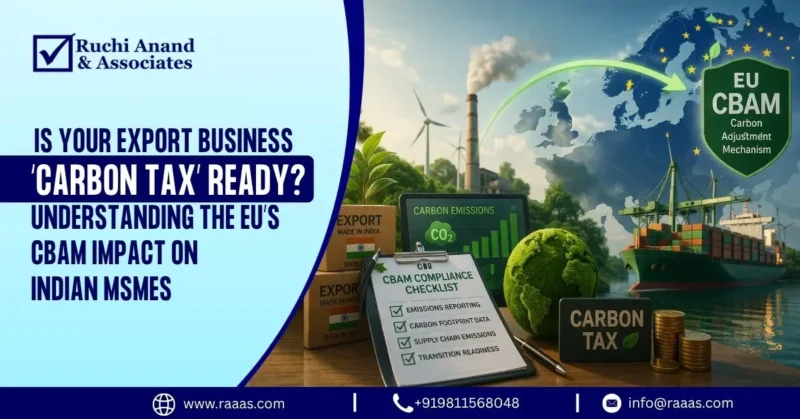
Is Your Export Business ‘Carbon Tax’ Ready? Understanding the EU’s CBAM Impact on Indian MSMEs
The global trade landscape is undergoing a seismic shift. Traditionally, global trade is influenced by tariffs, quality, and logistics. However, a new player has entered this field: Climate Policy.
As of January 2024, the European Union’s Carbon Border Adjustment Mechanism (CBAM) has officially moved from a theoretical policy to a functional reporting requirement. For Indian Micro, Small, and Medium Enterprises (MSMEs), this isn’t just “environmental news”—it is a critical financial and operational challenge that could determine the future of their export capabilities.
What is CBAM? The “Carbon Tax” Explained
The Carbon Border Adjustment Mechanism (CBAM) is the world’s first carbon tax levied at a border. It is meant to level the playing field between European Union-based manufacturers, who pay a “carbon price” in the European Union Emissions Trading System, and non-European Union-based manufacturers, who might have lower environmental standards.
The European Union’s “carbon pricing” of imports is meant to avoid “Carbon Leakage,” a situation where companies relocate to countries with lower environmental standards to save on costs.
The January 2024 Milestone: The Transition Phase
The CBAM will begin its transitional period from January 1, 2024. During this period (which lasts until December 31, 2025), exporters are not yet required to pay the tax, but they are legally mandated to report the embedded carbon emissions of their products on a quarterly basis.
For an Indian MSME exporting steel bolts or aluminum components to Germany or France, the “business as usual” approach ended this January. Failure to provide accurate data now can lead to penalties and, more importantly, a loss of “Preferred Supplier” status in the European market.
Why Indian MSMEs are at the Eye of the Storm
India is one of the top three trading partners impacted by CBAM, alongside China and Russia. Our exports in sectors like Steel, Aluminum, Cement, and Fertilizers are heavily concentrated toward the EU.
1. High Carbon Intensity of Indian Production
The Indian power grid remains heavily reliant on coal. According to industry data, the carbon intensity of Indian steel is roughly 2.5 to 2.8 tonnes of CO2 per tonne of steel, compared to the global average of 1.8 and the EU average of 1.3. This gap represents a significant “Carbon Debt” that will eventually translate into a cash tax.
2. The Data Gap
While large corporations like Tata Steel or Hindalco have the resources to track “Scope 1” and “Scope 2” emissions, MSMEs often lack the sensors, software, and specialized staff to calculate the “Embedded Emissions” in their production cycle.
3. Cost of Compliance
Compliance isn’t just about paying the tax; it’s about the cost of Business Sustainability Reporting in India. The MSMEs need to invest in energy audits and carbon accounting software, which is increasing their costs in a highly competitive market.
What Happened This January?
It appears that with the onset of the reporting requirement in January this year, the following trends have emerged in the Indian export sector:
- The Documentation Scramble: The European importers (the “Declarants”) have started sending out detailed questionnaires to the Indian suppliers. Many MSMEs have been caught off guard and have not been able to provide detailed information regarding the fuel type burned by their furnaces or the emissions from the raw material suppliers.
- Pressure on Margins: Although the tax is yet to be levied, the cost of hiring consultants and auditors to ascertain the emission data is beginning to impact the 5-10% margins that MSMEs currently enjoy.
- The Shift to “Green” Procurement: There are signs that importers in the EU might begin to diversify their supply chain to countries that have a “greener” mix in their grids, such as Norway or Canada, to reduce their future CBAM costs.
The Sector-Wise Breakdown: Who is Most Vulnerable?
Currently, CBAM covers six carbon-intensive sectors. If your MSME belongs to these categories, the clock is ticking:
- Iron and Steel: From raw materials to finished goods such as pipes and containers.
- Aluminum: From raw materials to finished goods.
- Cement: High impact due to the energy-intensive process of clinker manufacturing.
- Fertilizers: Impacted due to the use of natural gas and ammonia.
- Hydrogen: A niche but growing export area for India.
- Electricity: (Not so relevant for Indian MSMEs but part of the policy).
The Indian Response: Policy, Resistance, and the “Carbon Credit” Shield
While the EU’s CBAM is a European regulation, its ripples have caused a massive wave of policy activity within India. The Indian government and industry bodies are not merely passive observers; they are actively building a domestic ecosystem to protect Indian exporters from “Double Taxation.”
1. The Indian Carbon Credit Trading Scheme (CCTS)
In a strategic move to “keep the tax at home,” the Government of India has fast-tracked the Indian Carbon Credit Trading Scheme (CCTS). The logic is brilliant yet simple: Under CBAM Article 9, if an exporter has already paid a carbon price in their home country, that amount can be deducted from the EU tax.
By launching a domestic carbon market, India ensures that the money paid by Indian MSMEs for their emissions stays within the Indian economy—to be reinvested in green infrastructure—rather than flowing into the EU’s treasury.
2. High-Stakes Diplomacy and the WTO
India has officially flagged CBAM at the World Trade Organization (WTO), labeling it as a “disguised protectionist measure.” New Delhi argues that the tax violates the principle of “Common But Differentiated Responsibilities” (CBDR), which suggests that developed nations (who historically emitted more) should bear a higher burden than developing nations like India. These ongoing negotiations could lead to specific exemptions or longer transition timelines for Indian MSMEs.
3. The “Green Steel” Revolution
The Ministry of Steel and the Ministry of New and Renewable Energy (MNRE) are pushing for the National Green Hydrogen Mission. Since steel is one of the biggest casualties of CBAM, the government is incentivizing MSMEs to move away from coal-based Blast Furnaces toward Electric Arc Furnaces (EAF) powered by renewable energy.
4. Supply Chain Transparency: The New Compliance Standard
One of the biggest hurdles identified this January was the lack of “Plant-Level Data.” Large Indian steel producers often do not share granular emission data with the MSMEs who buy from them to manufacture downstream products (like nuts, bolts, or auto parts). To bridge this, Indian regulators are working on standardized Business Sustainability Reporting frameworks that will mandate transparency across the value chain, ensuring MSMEs aren’t penalized with “Default Values” (the highest possible tax rate) simply because they couldn’t prove their actual lower emissions.
Strategic Roadmap: How to Make Your Business ‘Carbon Tax’ Ready
In order to survive and prosper in the CBAM environment, Indian exporters need to shift from a reactive approach to a proactive approach. Here is a step-by-step guide for the same:
Step 1: Carbon Footprint Assessment
You cannot manage what you do not measure. The first step is to calculate your Scope 1 (Direct) and Scope 2 (Indirect – from purchased electricity) emissions. This forms the core of a sustainability report.
Step 2: Energy Efficiency Upgrades
No longer is it “good for the planet” to invest in LED lighting, efficient motors, and waste heat recovery systems; it’s a direct reduction in your future tax bill.
Step 3: Switch to Renewables
Going solar or buying “Green Power” through open access can significantly reduce your carbon intensity. In the view of the EU, a product made with 100% solar energy carries a far lower “Carbon Price Tag.”
Step 4: Digital Record Keeping
Moving away from paper records to a digital ERP system ensures that your records are “audit-ready.” The EU requires “verified” data; having a digital trail makes the verification process cheaper and faster.
The Silver Lining: A Competitive Advantage
CBAM may be a challenge, but it also creates a massive opportunity. Indian MSMEs have an opportunity to transform themselves into “Green Suppliers.” In a world where ESG scores are the basis of investment and purchasing decisions, “CBAM Ready” could be a Unique Selling Proposition.
Indian MSMEs should clean up their acts, and they don’t just secure their future in Europe but also in the UK, USA, and Canada, where “Carbon Taxes” are also in contemplation.
How Professional Guidance Can Help
Understanding the nuances of international tax laws and environmental regulations requires a multidisciplinary approach. It may be the management of the financial implications of carbon credits or ensuring that your data security while reporting meets international standards. It requires professional intervention.
At Ruchi Anand & Associates, we are committed to helping your business thrive in the complex world of modern trade and regulatory compliance. From traditional tax systems to the new world of sustainability reporting, our professionals are here to help your business become robust.
When your export business is growing, think about the importance of robust systems within your business. It may be the need for a Chartered Accountant in India to help you better understand your financial systems or one of the Top Indian Audit Firms to verify your sustainability reports.
Having your GST Registration In India optimized for exports, along with consulting a Tax Advisor In India, can create a fiscal buffer to invest in green technologies. Additionally, as you share more data with international consumers, the Best Data Security Audit Service takes on a new level of importance to protect your business’s intellectual property.
In the new world of CBAM, Business Sustainability Reporting In India is not a choice, it is a survival skill. We also help companies manage complex financial instruments like Share Based Payments in India to retain the talent that drives these green innovations. Finally, a rigorous Internal Audit in India can help identify inefficiencies in your production line before they turn into a carbon tax liability.
Is your business ready for the green revolution? The transition has already begun.
For more insights on international trade compliance and financial excellence, visit our blog at www.Ruchi Anand & Associates.com.