
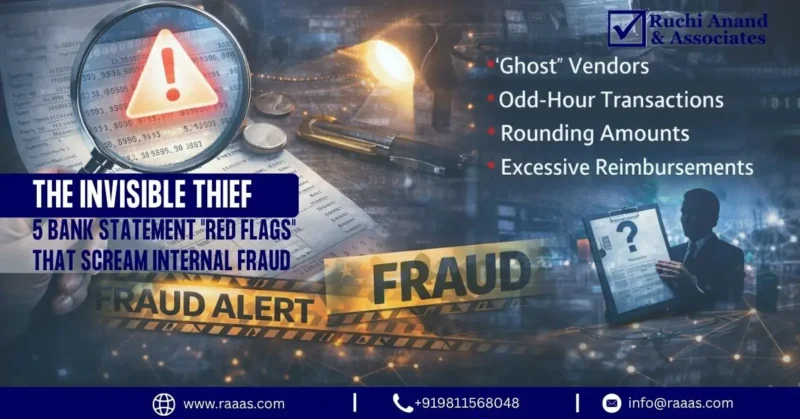
The Invisible Thief: 5 Bank Statement “Red Flags” That Scream Internal Fraud
In the modern corporate landscape, trust is the bedrock of any successful enterprise. However, trust—when left unverified—can become a significant liability. Occupational fraud, or internal fraud, costs organizations worldwide an estimated 5% of their annual revenue. For a business operating in the complex regulatory environment of India, these losses don’t just hit the bottom line; they invite legal scrutiny, tax complications, and permanent reputational damage.
The most honest story of a company’s health is often told not in the glossy pages of an annual report, but in the granular, line-by-line entries of its bank statements. To the untrained eye, a bank statement is a boring list of numbers. To a forensic auditor, it is a crime scene.
The Anatomy of the Fraud Triangle
Before diving into the bank statement red flags, it is essential to understand why fraud happens. In the auditing world, we refer to the Fraud Triangle.
- Pressure: The motive. It could be personal debt, lifestyle inflation, or even a medical emergency.
- Opportunity: The “how.” This is where the weak internal controls at the bank entry level allow the employee to move the money undetected.
- Rationalization: The “excuse.” The employee rationalizes in their own mind that they are merely “borrowing” the money or that they are “underpaid.”
By recognizing the red flags in your bank statement, you are essentially closing the “Opportunity” side of the triangle.
1. The “Ghost” Vendor: Payments to Unrecognized Entities
One of the most common internal fraud schemes involves the use of so-called “shell companies.” A dishonest employee in the accounts department creates a fake vendor in the system and starts making payments for “services rendered,” which never occurred in the first place.
The Red Flag:
Look out for regular payments made to companies which are not present in the approved vendor master list. These would include regular payments made at rounded-off amounts (for example, exactly ₹50,000 instead of ₹49,842) or payments made just below the threshold for senior management approval.
Forensic Deep-Dive:
In many Indian SMEs, the vendor master list is not well maintained. A fraudster might name his or her shell company something generic like “Universal Trading Solutions” or “Standard Consulting Services” to fit in with legitimate vendors.
What to look for on the statement:
- The Address Match: This is a quick check to ensure that the vendor’s registered address matches an employee’s home address.
- Sequential Invoice Numbers: If you receive Invoice #001, #002, and #003 from a vendor over six months, it means you are their only client. This is a massive red flag.
2. Odd-Hour and Weekend Transactions
Business hours are usually cyclic. In India, the majority of the transactions happen during standard banking hours. While digital banking is 24×7, internal controls would suggest that the financial transactions happen only during business hours when the “Maker-Checker” system is enabled.
The Red Flag:
A spike in banking transactions occurs on Sundays/holidays/at 3 AM. Scammers often wait for the office to be empty before conducting transactions during “eyes-off” hours, thinking the transactions of the next Monday morning would hide the evidence of the crime.
The “Log-In” Audit:
Banking websites now have logs of the user login attempts from the IP addresses. If your bank statement shows a transfer at 2:00 AM on a Saturday, cross-reference it with your office biometric logs. If no one was in the office, but the transaction was initiated from an office IP via VPN, you have a security breach or an internal thief.
3. Frequent “Rounding” and Even-Amount Transactions
In the real world of commerce, prices are messy. They include GST (5%, 12%, 18%, or 28%), professional tax, TDS deductions, and paise. It is mathematically improbable for a series of legitimate business transactions to consistently result in perfectly round numbers.
The Red Flag:
If your statement is filled with transfers involving ₹1,00,000, ₹2,50,000, and ₹5,00,000 without any decimals or odd figures, then you are probably dealing with “plug numbers.”
Benford’s Law in Auditing:
Forensic auditors use Benford’s Law, which is a mathematical theory based on the frequency distribution of digits. In natural transactions, the number “1” occurs as the first digit 30% of the time, while the number “9” occurs as the first digit less than 5% of the time. When humans “make up” numbers for fraudulent activities, they do so evenly – which gives it away for a Chartered Accountant in India!
4. Excessive “Miscellaneous” or “Reimbursement” Entries
The “Miscellaneous” category is where transparency goes to die. Internal fraudsters tend to exploit the reimbursement channel due to its relative lack of scrutiny compared to payments to vendors.
The Red Flag:
A steady and unexplained growth in “Employee Reimbursements” or “Petty Cash Replenishments” that is not commensurate with business growth. Specifically, look for multiple reimbursements just under the “receipt required” limit. For example, if your policy requires a receipt for anything above ₹2,000, keep an eye out for a flurry of ₹1,950 or ₹1,990 entries.
The “Double Dip”:
A common fraud involves an employee paying for a legitimate business expense on a corporate card and then submitting the same receipt for a cash reimbursement. The bank statement will show both the credit card payment and the cash withdrawal—effectively paying for the same item twice.
5. Sudden Changes in Vendor Bank Details
A sophisticated fraudster won’t create a new vendor; they will hijack an existing, trusted one. They do this by changing the bank account details of a legitimate supplier in your system to their own personal account or a “mule” account.
The Red Flag:
On the bank statement, the payment description says “Payment to Tata Power,” but the actual recipient account number has changed from the one used for the last three years.
Social Engineering and Fraud:
The employee might claim the vendor sent an email saying, “We have changed our bank branch; please update your records.” Without a direct phone call verification to the vendor’s known finance head, the money is diverted. This is why a Best Data Security Audit Service is vital—it checks not just for hackers, but for internal data integrity.
6. (Bonus Flag) The “Reverse” Transaction: Unexplained Credits followed by Debits
Sometimes, fraud involves “testing the pipes.” An employee might initiate a small credit to the company account from an unknown source, followed by a larger debit. Or, they might overpay a vendor deliberately, then call the vendor to ask for the “refund” to be sent to a “different corporate account” (which is actually the employee’s account).
Why this is Dangerous:
This manipulates the bank reconciliation process. If the “In” and “Out” match, an automated system might not flag it, but the destination of the “Out” is what matters.
Legal and Regulatory Framework in India
Under the Companies Act, 2013, specifically Section 143(12), auditors are required to report fraud to the Central Government if the amount exceeds ₹1 Crore. However, for smaller amounts, the responsibility lies heavily on internal controls.
As the Indian economy moves toward a $5 Trillion goal, the GST Registration In India and the subsequent filing process have made it harder to hide fake invoices, but not impossible. Fraudsters are now using “Credit Note” manipulation to siphon off GST inputs.
The Importance of Internal Audit
An Internal Audit in India is no longer just a compliance checkbox; it is a survival mechanism. A robust audit identifies these 5 red flags in real-time. Furthermore, with the rise of Business Sustainability Reporting in India (BRSR), transparency in financial dealings has become a metric for ESG (Environmental, Social, and Governance) scores.
Strategic Prevention: A Checklist for CFOs
To ensure your bank statements remain “clean,” implement the following:
- Mandatory Vacations: Fraudsters often can’t take time off because their scheme requires daily “maintenance” to hide. Force your finance team to take 10 consecutive days off once a year.
- Surprise Reconciliations: Don’t wait for the end of the quarter. Have a Tax Advisor In India or an external firm perform a surprise check on a random Tuesday.
- Audit Trail Monitoring: Ensure your ERP (Enterprise Resource Planning) software has an unchangeable audit trail. Every time a bank account number is changed, an alert should go to the CEO.
- Share-Based Incentives: Sometimes, fraud is born of a lack of skin in the game. Even Share Based Payments in India can help align employee interests with company long term, and these need auditing for compliance as well.
Conclusion: Partnering for Financial Integrity
Fraud is not committed overnight; it is a slow leak that will eventually sink the ship. Knowing what to look for on your bank statement is the first step in building a fortress around your finances. But in today’s complex business environment, you need more than just a keen eye for detail—you need someone who knows the DNA of finance in India.
At RAAAS, our speciality is helping you convert financial information into a shield for your business. Whether you are looking at overcoming the initial challenges of GST Registration In India or need a Tax Advisor In India for long-term growth, our expertise helps you build your business on a foundation of integrity.
At our esteemed firm of Chartered Accountants In India, we take pride in being among the Top Indian Audit Firms. Our holistic approach covers everything from a rigorous Internal Audit in India to providing the Best Data Security Audit Service to prevent digital embezzlement. We also guide maturing companies through the complexities of Business Sustainability Reporting in India and the legalities of Share Based Payments in India.
Protect your legacy. Watch the numbers, but trust the experts.
Would you like me to create a detailed “Fraud Detection Worksheet” that your finance team can use during their monthly closing?