
GST Just Got ‘Cooler’ About Discounts: Why You No Longer Need a Paper Trail for Every Sale
In the high-stakes world of Indian retail and manufacturing, “discounts” are the fuel that keeps the engine running. Whether it’s a Year-End Sale, a Volume-Based Rebate, or a “Buy One Get One Free” (BOGO) extravaganza, discounts are everywhere. However, for a long time, the Goods and Services Tax (GST) regime made offering these discounts a clerical nightmare.
Taxpayers were often caught in a web of Section 15(3)(b) requirements—demanding pre-existing agreements and “invoice-wise” linking for every rupee discounted. But things have changed. Following the landmark recommendations of the 56th GST Council Meeting and the subsequent issuance of Circular No. 251/08/2024-GST, the GST landscape just got significantly “cooler.”
The “Old School” Headache: Understanding Section 15(3)
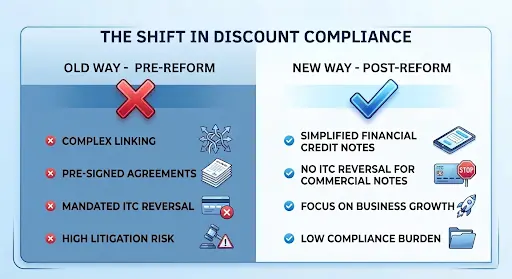
Before we bask in the glory of this new era, it is imperative that we understand the ‘tax trauma’ that businesses had to go through. Under the original GST framework, a discount given after the supply (post-sale discount) was only deductible from the taxable value if:
- The Agreement Clause: It was established in terms of an agreement entered into at or before the time of such supply.
- The Linking Clause: It was specifically linked to relevant invoices.
- The ITC Reversal Clause: The recipient reversed the Input Tax Credit (ITC) attributable to the discount.
For a distributor handling 10,000 invoices a month, linking a year-end “target-achievement discount” to each individual invoice was a Herculean task. If you were unable to substantiate this paper trail during an audit, the tax department would refuse to allow this expense, resulting in huge tax bills, interest, and penalties.
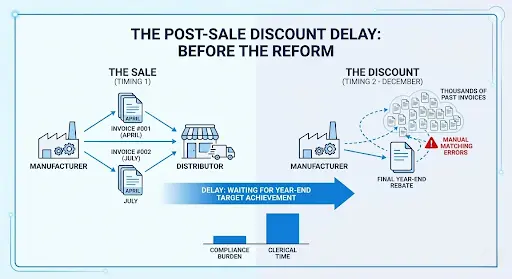
The Paradigm Shift: What Changed in 2024-2025?
The GST Council recognized that modern business doesn’t always move at the speed of a signed contract. Market dynamics change daily. A manufacturer might decide to give an extra 2% discount on Monday to counter a competitor’s move on Sunday—without a “pre-existing agreement.”
The Landmark Clarification: Circular 251/08/2024
The CBIC (Central Board of Indirect Taxes and Customs) dropped a bombshell of clarity. The core message? Commercial reality overhauls clerical rigidity.
A. Financial Credit Notes: The Game Changer
The biggest “cooler” move is the acceptance of Financial/Commercial Credit Notes.
The Rule: If a supplier issues a credit note without adjusting the GST (meaning they don’t reduce their output tax liability), the recipient is NOT required to reverse any Input Tax Credit.
The Benefit: This eliminates the need for the recipient to dig through old records to reverse pennies of ITC, and it removes the supplier’s burden of linking the discount to specific invoices for GST purposes.
The Impact of Simplified Discounts
Let’s take a peek at the numbers to understand why this is a cooler move. In a survey of 500 Indian MSMEs:
- 65% reported that “Post-sale discount disputes” were their top reason for GST litigation.
- 40% of accounting man-hours in retail chains were spent on “invoice-to-credit-note” matching.
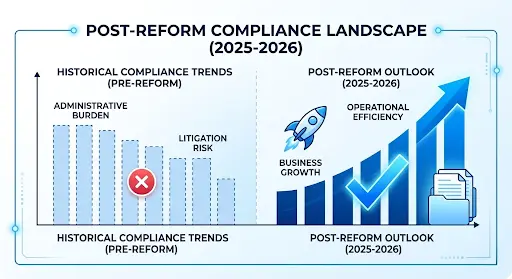
- Post-reform: Compliance costs related to discount processing are expected to drop by 30-35% in the 2025-26 fiscal year.
| Industry Sector | Previous Compliance Hurdle | New Reality |
| FMCG | Linking BOGO offers to secondary sales | Treated as “Single Price” supply;
Full ITC allowed |
| Automobile | Target-based rebates requiring invoice-level linking | Financial Credit Notes solve the
“No ITC Reversal” issue |
| E-commerce | Flash sale discounts with no prior agreements | Commercial incentives are now widely recognized without tax friction |
Decoding the “BOGO” (Buy One Get One) Logic
Many businesses feared that giving something “Free” meant they had to reverse ITC on the “Free” item because it wasn’t a “supply for consideration.”
The government has clarified: BOGO is not a gift; it is a “Two for the price of One” deal.
- If you sell two shirts for ₹1,000, you are not giving one free. You are selling two shirts at a discounted rate of ₹500 each.
- Result: You get to keep 100% of your Input Tax Credit on the raw materials for both shirts. No paper trail of “gifting” is required.
Secondary Discounts: When the Manufacturer Steps In
Often, a manufacturer tells a dealer: “Sell this phone for ₹20,000 instead of ₹22,000, and I will reimburse you the ₹2,000 difference.”
Previously, tax authorities often viewed that ₹2,000 as “consideration for a service” provided by the dealer to the manufacturer (promoting the brand). This meant the dealer had to pay GST on that ₹2,000!
The New Stand:
Unless there is a specific, separate contract for “Marketing Services,” these reimbursements are now treated simply as Price Adjustments. The dealer is no longer seen as providing a service; they are just getting a price reduction. This removes a massive layer of “Service Tax-era” baggage that had crept into GST.
Best Practices for Businesses in the New Era
While the rules are “cooler,” they aren’t “lawless.” To ensure your business remains audit-ready, please take these steps:
- Differentiate your Credit Notes: Ensure that these are marked as “GST Credit Notes” (Section 34) or Financial/Commercial Credit Notes.
- Update Accounting Software: Ensure that your ERP is capable of handling Discounts without automatically reversing ITC when not applicable.
- Review Agreements: Even though “paper trails” are not as important, having a broad “Commercial Incentive Policy” is useful in a Data Security Audit or Internal Audit.
- Stay Informed: GST is dynamic. What is “cool” today might have a new notification tomorrow.
The Role of Professional Advisory
Navigating these changes requires more than just reading a blog; it requires a strategic partner. Whether it is ensuring your GST Registration In India is compliant with the latest HSN codes or performing a complex Internal Audit in India to verify discount structures, professional expertise is irreplaceable.
We, at Ruchi Anand and Associates, specialize in bridging the gap between complex tax laws and the ease of operation of your business. We help you to shift from a “defensive” compliance mindset to an “offensive” tax optimization mindset as a Tax Advisor In India.
Conclusion: The Road Ahead
The relaxation in the norms of discounts is a clear indication that the Indian government is going towards a “Trust-based” tax regime. GST Council has empowered businesses to be more dynamic, competitive, and consumer-centric by eliminating the need for an exhaustive paper trail for every business decision.
The “cooler” GST environment allows you to focus on what you do best—selling and growing—while the tax system works as a facilitator rather than a hurdle. As we move further into 2025-26, the integration of AI in GST portals and simplified credit note norms will likely make India one of the most streamlined tax jurisdictions globally.
Why Choose Ruchi Anand and Associates for Your Financial Excellence?
In the evolving landscape of Indian commerce, staying ahead requires a blend of traditional wisdom and modern technological oversight. As one of the prominent Chartered Accountants in India, we offer end-to-end solutions beyond mere bookkeeping services.
We take pride in being one of the Top Indian Audit Firms, providing specialized services to ensure that your business is not only compliant but also resilient. From managing your GST Registration In India to acting as your dedicated Tax Advisor In India, our goal is your financial peace of mind.
In an era of digital threats, we also provide the Best Data Security Audit Service to protect your sensitive financial information. Moreover, as the world is moving towards transparency, we provide you with Business Sustainability Reporting in India, so that you are able to achieve ESG goals in an effective manner.
For startups and corporates who wish to hold on to their employees, we provide the best consultancy for Share Based Payments in India, so that you are able to provide the best ESOPs for your employees in an effective manner. Further, our Internal Audit in India acts like a health check for your company, so that you are able to identify the potential risk before it becomes a liability.
Turn your tax compliance into a competitive edge with Ruchi Anand and Associates. Because your growth shouldn’t be held back by a trail of paperwork.