
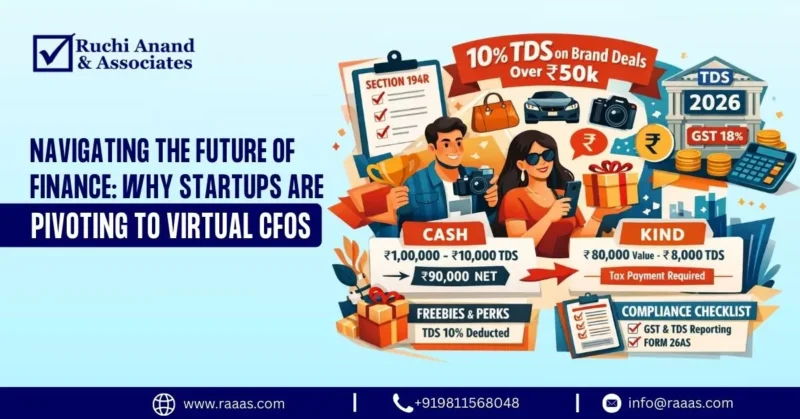
The Influencer Audit: Why Brand Collaborations Over ₹50k Now Face a 10% TDS Sting
The digital space in India has experienced a seismic shift, moving from a space used for casual “vlogging” to a multi-billion dollar creator economy. In the year 2026, the term “Social Media Influencer” is no longer just a buzzword, but a recognized profession with its own taxation codes. However, with this newfound professional status comes a significant layer of regulatory scrutiny.
If you are an influencer, a creative agency, or a brand manager, Section 194R is the most critical compliance hurdle you must clear. Recent updates from the Central Board of Direct Taxes (CBDT) have tightened the rules around perks, “free” products, and high-value barter deals. For any collaboration where the benefits exceed ₹20,000 annually, a mandatory 10% Tax Deducted at Source (TDS) now applies. For high-ticket deals crossing ₹50,000, this “sting” is transforming the way business is done.

The Genesis of Section 194R: Plugging the “Freebie” Gap
For years, the influencer marketing industry thrived in a “tax-free” grey zone. Brands frequently bypassed traditional payment routes by gifting luxury cars, the latest smartphones, or international vacation packages to creators in exchange for content. Because no cash changed hands, these perks rarely appeared in bank statements or income tax returns.
The Indian government estimated that billions of rupees in taxable benefits were going unreported. In response, the law now includes Section 194R, which makes sure that all “benefit or perquisite” arising from a business or profession is captured.
Why the ₹50,000 Threshold Matters
While the law stipulates a minimum of ₹20,000 as the TDS, the sweet spot for premium brands is ₹50,000, as the tax implications (which are in excess of ₹5,000) become a meaningful cost for the brand as well as a meaningful credit for the influencer.
Cash vs. Kind: Decoding the “Sting”
The most common misconception is that TDS only applies to bank transfers. Under Section 194R, the tax is applicable regardless of the medium of payment.
A. Benefits in Cash
This is straightforward. If a brand signs an influencer for a ₹1,00,000 campaign:
- Total Contract Value: ₹1,00,000
- TDS (10%): ₹10,000
- Net Payout: ₹90,000
- Reflected in: Form 26AS and AIS (Annual Information Statement).
B. Benefits in Kind (The Barter Deal)
This is where the “sting” occurs. If a brand gifts an influencer a high-end camera worth ₹80,000:
- Fair Market Value (FMV): ₹80,000
- TDS Liability: ₹8,000
- The Compliance Hurdle: The brand cannot hand over the camera until they ensure the ₹8,000 tax has been paid to the government.
How is this resolved?
- Influencer Pays: The influencer pays the ₹8,000 to the brand, which the brand then deposits as TDS.
- Brand “Grosses Up”: The brand pays the ₹8,000 out of their own pocket, treating the total value of the gift as ₹88,888 (approx.) to cover the tax.
The “Product Return” Loophole: What’s Taxable and What’s Not?
One of the most frequent questions handled by our team at Ruchi Anand and Associates involves products used temporarily for content creation.
| Scenario | Tax Treatment | Why? |
| Review & Return | No TDS | No permanent benefit or transfer of ownership occurred. |
| Review & Retain | 10% TDS Applies | The influencer now owns an asset of value (Perquisite). |
| Brand Events | No TDS (Usually) | Expenses incurred for travel/food for a brand event are generally not perquisites if they are for business purposes. |
| Personal Gifts | TDS Applies | If the gift is linked to the influencer’s profession (e.g., a phone to a tech reviewer), it’s taxable. |
Double Trouble: The GST and TDS Overlap
For successful creators, Section 194R is only half the battle.If your turnover is more than ₹20 Lakhs, you are legally bound to register your business under the GST regime in India.
- GST Rate:The services provided by you as an influencer fall under the head of Social Media Marketing. This attracts an 18% GST rate.
- The Trap:If a laptop worth ₹1,00,000 is given as a gift to you, the government treats this as a “Supply of Service” for a non-monetary consideration. You technically become liable for paying an 18% GST on the gift.

Accounting Treatment: Booking “Free Gifts” in the Ledger
For brands and audit firms, the accounting of the perks given to the influencers has to be precise so that no penalty is levied during the tax audit.
- Valuation: The Purchase Price of the item by the brand or the Price Charged to Customers for the item manufactured by the brand has to be used as the Fair Market Value.
- Documentation: A “Perquisite Register” has to be maintained. The PAN of the Influencer, Date of Transfer, FMV, and TDS Challan Number have to be filled in.
- TDS Returns: These are required to be filled on a quarterly basis in Form 26Q.
Global Perspective: How India Compares
India is not alone in taxing the creator economy; however, the method of Section 194R is particularly aggressive.
- USA (IRS):The Fair Market Value of all gifts needs to be reported as income by the Influencer. However, there is no TDS provision as in India.
- UK (HMRC): Gifts are taxable if they are “reward for services.
- India:The onus is on the Brand to deduct taxes before providing the gift, making India one of the most compliant-heavy regions for influencer marketing.
The 20-Point Compliance Checklist for Brands
If your brand engages with influencers, your internal audit team must verify the following:
Pre-Campaign
- Verify the Influencer’s PAN and Aadhaar.
- Determine if the influencer is a Resident or Non-Resident (TDS rates differ).
- Define the FMV of any products to be sent.
- Draft a contract explicitly mentioning who will bear the TDS on kind-benefits.
During Campaign
- Track the “Aggregate Value” for each influencer across the financial year.
- Ensure TDS is deducted the moment the threshold of ₹20,000 is breached.
Post-Campaign
- Deposit TDS by the 7th of the following month.
- Issue Form 16A to the influencer so they can claim the credit.
- Reconcile GST invoices with TDS entries to ensure no “Reverse Charge” (RCM) liabilities are missed.
Strategic Financial Planning with Ruchi Anand and Associates
The “Influencer Audit” is more than just a tax check; it is a move towards legitimizing the industry. Failure to follow these rules may result in severe penalties for the brand, which may go as high as 100% of the tax amount and may also disallow the marketing expenses.
At Ruchi Anand and Associates, we know that you are an entrepreneur and that you want to grow as a brand in a seamless manner. Our experience as a Premier Chartered Accountant in India enables us to simplify complex rules for you. We are also one of the Top Indian Audit Firms that ensures that you grow in a compliant manner.
We help you with GST Registration in India and ensure that you are on the right side of the law as you grow in terms of turnover. We also help you as a Tax Advisor in India in reducing your tax outgo by identifying legitimate professional expenses.
Beyond taxation, we offer the Best Data Security Audit Service to protect your digital assets and contracts. For larger organizations, we provide Business Sustainability Reporting in India and specialize in the valuation and taxation of Share Based Payments in India—a growing trend where startups offer equity to top-tier creators. Our Internal Audit in India is the final shield for you as a brand. We help you in perfectly documenting every payment that you may have to make to an influencer in cash or kind.